Showing posts with label empowerment. Show all posts

Thursday, June 18, 2020

Ensuring Your Team Feels Valued

Source: needpix.com 
Aytekin Tank, founder of JotForm, has crafted a useful column for Fast Company titled, "4 ways to ensure your team feels valued without in-person connections."  Tank acknowledges that it can be very challenging for leaders to make team members feel valued when so many are working remotely, resources are scarce, and the stress is very high.   The article notes that, "A recent Gallup report showed that only one in three U.S. workers 'strongly agreed' they received recognition for their work in the past seven days. Employees who don’t feel recognized are twice as likely to say they’ll quit in the next year."   Given this reality, Tank offers four strategies for ensuring that team members feel valued.  

GIVE YOUR TEAMS THE TOOLS THEY NEED:  What technology, supplies, and other resources do your employees need to work effectively in a remote mode?  Like a good coach, put your team members in the best position to thrive and win.  

MAKE TIME TO LISTEN AND CONNECT:  Keep up the informal check-ins with your employees.  Don't just inform them about what you are doing or what the organization is planning.  Make sure to listen to their concerns, questions, and needs.  Open up about yourself a bit; let them see a different side, perhaps a bit about your personal/family situation.  Letting them see you as human can be very important for connecting with them, and encouraging them to be candid with you.  

INCREASE TRANSPARENCY: Provide regular updates on key initiatives and metrics.  Be honest about the challenges facing the organization.   Let them know exactly where things stand.  If you don't have everything figured out in terms of plans for the coming months, that's ok.  Let them know your decision-making process, how their input will be incorporated, and the criteria you will use to make final choices.  

OFFER TANGIBLE REWARDS: You might not be able to offer bonuses or raises this year.  What can you do to reward your employees?  Tank suggests offering time off in the future (days that they can bank now for future use), or providing new professional development opportunities.  Other forms of recognition and reward might include supporting causes about which the employees care a great deal, or perhaps providing paid time for team members to volunteer in the community.  

Thursday, November 15, 2018

Who Interacts with the Customer?

Source: USAF Civil Engineer Center
Patrick Gorman recently published an interview with Susan Story, CEO Of American Water Works Company for ChiefExecutive.net.   In that interview, Story describes what it means to be customer-focused.  She explains that, "If you're customer-focused, the next step, is, there's no bad idea and pepole can push back."  That's an interesting connection between customer focus and employee empowerment.  Story argues that you can't say you are customer-focused if you haven't created a culture where the people responsible for interacting with the customer every day have the ability to speak up, challenge the existing ways of working, and offer new ideas.  Story offers an example: 

I’ll give you a great example of the change we’ve made in technology. Several years ago we had a new back office software system put in and the people on frontlines weren’t asked about it. It was very rigid and our employees on the frontlines hated it. And it actually slowed down their ability to deliver customer service.

So with our new chief technology and innovation officer, we got a group of 13 field service reps from all over the country to and said, “Tell us what you need.” And we had technologists in the room and they built what the frontline employees told them they needed and they did it quickly. They met in April by July 31st, they had a prototype, they’re out in the field using it, they got feedback, and by the end of the year, we deployed it to 1,800 field service reps around the United States.

And I think that one of the biggest changes that we’ve made is that we’re trying to let our frontline employees dictate how we do our business, because they’re the ones interacting with our customers every day.

In too many instances, I think senior executives ASSUME that they know what customers want.  They jump to conclusions based on a few anecdotes, or they cling to beliefs about customers that may have been true in the past, but no longer hold.  They also don't empower those closest to the customer to share what they know, and what they have experienced through their interactions with the customer.  Some senior leaders spend a great deal of money hiring consultants to tell them what customers want, while never asking the people on the front lines of their own organizations about customer needs, wants, and pain points.  

Thursday, May 10, 2018

Making Sure People Recognize Their Impact

Adam Bryant, formerly of the New York Times, interviewed Deborah Bothun recently and posted her comments on LinkedIn.   Bothun spent 21 years at PricewaterhouseCoopers.  The two now owrk together at Merryck & Co, a leadership development consultancy.   Bothun explains that she wants everyone in an organization to understand that they can make an impact on the customer, the organization's mission, and the P&L.   She explains about the latter in this excerpt:

Another one of my themes is that often people don’t think of their role as having a P&L impact. Everybody’s role ultimately has a P&L impact. No matter what functional area you’re in, you need to be responsible for the commercialization of that organization.   Regardless of what you do, you need to understand how what you do drives revenue or drives cost. That way, you become more knowledgeable about the drivers in your area and how they intersect with the drivers of growth in other areas, and you become more integrated into the whole team. And if you can start to think that way, you’re going to have a much better chance of moving in the direction you want.

I'm in full agreement with Bothun.  If people at all levels understand how they can make an impact, they can be encouraged and empowered to bring forth ideas for making the organization more successful.  People will be more motivated if they recognize the ways in which their work matters, and how their efforts can enhance the organization's overall success.  

Tuesday, June 06, 2017

Making People Feel That They Count

Andrea Illy, CEO of Illy Coffee, talks in this short video about how important it is for people to feel that they "count" in an organization.

Tuesday, August 19, 2014

Does Certain Music Make Us Feel Powerful and Act Differently as a Result?

Dennis Hsu, Li Huang, Loran Nordgren, Derek D. Rucker and Adam D. Galinskyhave conducted some interesting new research regarding the impact that music has on our behavior.  According to Kellogg Insights, the key research question that these scholars asked was: "Could listening to the right kind of music—even in the background—make us feel more powerful and in control?"  The scholars conducted several experimental studies to try to answer this question.  The researchers first had a set of subjects rate different songs with regard to how powerful, dominant, and determined they felt when listening to that particular music.  For instance, the famous Queen song, We Will Rock You, was rated very highly... it made most subjects feel powerful.   Then they conducted studies using the music that subjects had rated as either high-power or low-power songs. 

For instance, Professor Derek Rucker noted, “One thing we know from prior research is that people who feel powerful tend to make the first offer in negotiations. Essentially, power is a propensity to act, to take charge of the situation."   One of these experimental studies indeed showed that people listening to a "high-power playlist" indicated that they would prefer to go first in a debate more often than those who listened to a "low-power playlist."  

In sum, music - even in the background - does affect how we feel, and it may affect how we behave in crucial situations.   It can have a significant effect on our feelings of psychological empowerment.  So, what song do you want to play next time you have to enter a crucial meeting or negotiation at work?  

Tuesday, July 24, 2012

The Language of Empowerment: Leading Differently

Source: Wikimedia Commons
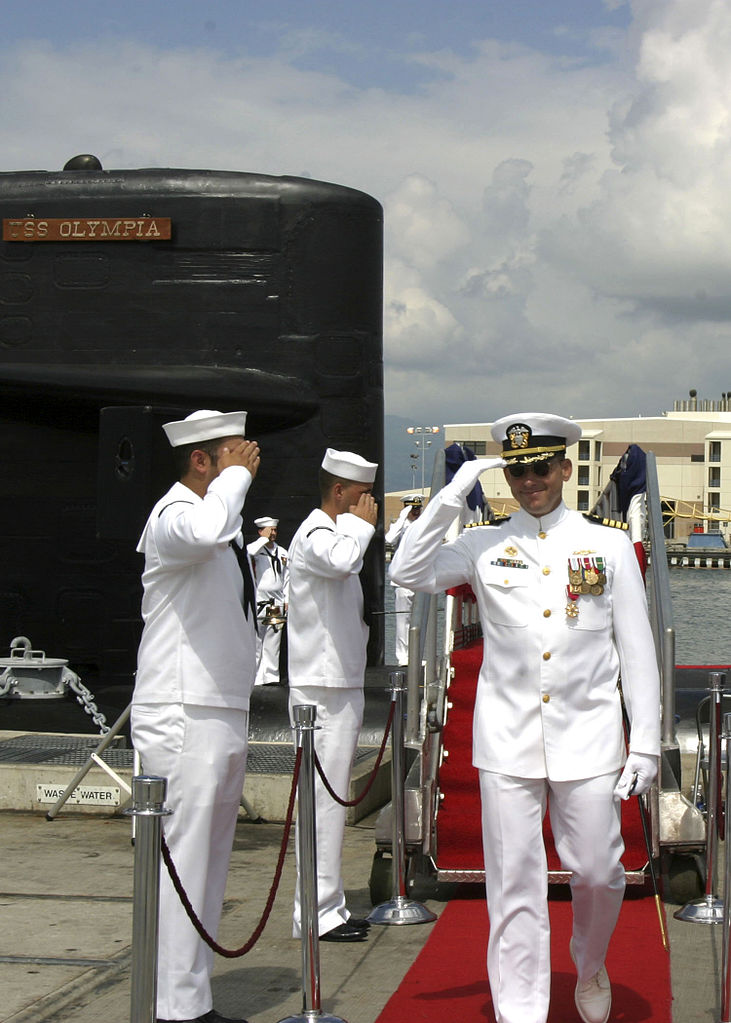
David Marquet, Captain, U.S. Navy (Retired), has written a good article on Fast Company's website about his leadership philosophy.   Marquet used to command a nuclear submarine for the U.S. Navy.  He describes how leaders can make the shift from a top-down, command-and-control approach to a model that stressed empowerment and accountability at all levels.  Marquet emphasizes the importance of language as a tool for changing the way people view the leader-subordinate relationship:

The key to your team becoming more proactive rests in the language subordinates and superiors use.
Here is a short list of "disempowered phrases" that passive followers use:
  • Request permission to . . .
  • I would like to . . .
  • What should I do about . . .
  • Do you think we should . . .
  • Could we . . .
Here is a short list of "empowered phrases" that active doers use:
  • I intend to . . .
  • I plan on . . .
  • I will . . .
  • We will . . 
Marquet doesn't want action to begin with an order from the commander.  Instead, he wants action to begin with an empowered subordinate coming up with a recommended course of action.  Then, the subordinate should explain their plan ("I intend to").  The commander reacts to that recommendation, rather than simply barking out orders.   The change in language may seem trivial, but it emphasizes a shift in responsibility.  It pushes the burden down upon the subordinate to proactively come up with a plan of action and to recommend it to the "boss" - rather than having subordinates wait passively to be told what to do.