Showing posts with label confirmation bias. Show all posts

Thursday, May 20, 2021

A Stubborn Attachment to Existing Beliefs

Source: Rand Corporation
In 1962, Roberta Wohlstetter published a fascinating book titled, "Pearl Harbor: Warning and Decision."   She examined why officials did not perceive the threat of a potential attack in Hawaii appropriately.   She opened her book by writing, "It would be reassuring to believe that Pearl Harbor was just a colossal and extraordinary blunder.  What is disquieting is that it was a supremely ordinary blunder." Later, in assessing the decision making of key leaders, she notes how many of them held a strong pre-existing belief that the Japanese would never attack the United States. That belief clouded their assessment of data and signals, and ultimately led to misguided judgments. She wrote, "Apparently human beings have a stubborn attachment to old beliefs and an equally stubborn resistance to new material that will upset them."  Truer words have never been written. 

I'm reminded of this quote when I think about an organization I've been studying for quite some time.  This once very successful organization made a series of strategic decisions more than a decade ago based on a core set of beliefs and assumptions.   Those beliefs and assumptions were consistent with the strong preferences of senior leaders - i.e., they aligned quite well with the interests and aspirations of top managers and board members.  Years later, quite a bit of evidence suggests that some of those assumptions were invalid.  Yet, leaders remain stubbornly attached to those beliefs.   They haven't been willing to confront the data, question those beliefs, and change course.  

Poor governance practices have exacerbated the problem, as board members prefer not to question the assumptions or the strategy, given that some of the initiatives were "pet projects" in which they were emotionally invested.  Less than desirable outcomes and results are constantly rationalized away, much like a retailer that explains away its poor financial results during a particular quarter by pointing to "weather conditions" that reduced traffic to its stores.  Funny how quarterly financial reports never seem to talk about favorable weather conditions bolstering sales and profits!  

Perhaps the most frustrating element of this story is that the stubborn attachment to existing beliefs has not only led to an unwillingness to change direction or abandon misguided plans, but has led to a "doubling down" on failed policies.  The sunk cost trap is clearly at play.   The organization finds itself throwing good money (and effort) after bad.  The problem, as is often the case, is not simply the prior investment of financial resources.  It's the huge emotional sunk cost; it's the unwillingness to admit when one is wrong.  

Whenever you witness the sunk cost trap in action, you should not only pay attention to the wasted resources as good money is thrown after bad.  One should also pay close attention to the opportunity costs. What opportunities have been missed and what investments have NOT been made because so many resources continue to be allocated based on a stubborn attachment to long-held beliefs and assumptions?  In this particular organization I've studied, the opportunity costs in many ways have been far more substantial than the actual expenditures wasted in support of invalid beliefs and assumptions.  

Has your organization found itself in this predicament?  How can you as a leader help to identify implicit and explicit assumptions and beliefs that need to be tested, challenged, and validated?  How can you protect against the stubborn attachment that Wohlstetter wrote about so eloquently nearly sixty years ago?

Monday, July 29, 2019

Reducing Confirmation Bias

Can students be trained in a way that helps reduce confirmation bias on an unrelated task/decision in the near future?  Anne-Laure Sellier, Irene Scopelliti, and Carey K. Morewedge set out to addressz tha the question an interesting study.  They have published their results in an article titled, "Debiasing Training Improves Decision Making in the Field."

They offered students an opportunity to participate in a serious game-based training exercise.  They informed the students that this exercise could improve their "managerial decision-making ability." The exercise took 80-100 minutes. The scholars report that, "The one-shot debiasing intervention consisted of playing a serious video game, “Missing: The Pursuit of Terry Hughes.” Playing this game once has been shown to significantly reduce the propensity of players to exhibit confirmation bias..."  

At least six days later, and in some cases well over a month later, students worked to solve the "Carter Racing" business case during one of their regular class sessions.  The case is based loosely on the Challenger space shuttle launch decision, and it had nothing to do with the game-based training that they had experienced earlier.  If you avoid confirmation bias, you have a better chance of making a sound decision in the Carter Racing case.   

The results were quite striking. The scholars report, "Trained students were 29% less likely to choose an inferior hypothesis-confirming case solution than were untrained students. A reduction in confirmatory hypothesis testing appeared to explain their improved decision making in the case." Why did this significant impact occur? They do not know for sure, but they speculate that perhaps, "Games may be uniquely engaging training interventions."   Since we could all benefit from avoiding confirmation bias, I found the intervention interesting and useful as we begin to think about how to develop the decision-making abilities of leaders.   

Thursday, July 20, 2017

Avoiding Confirmation Bias

Earlier this year, Tom Stafford wrote a column for the BBC's website about how to combat confirmation bias.  In other words, how do we avoid the problem of searching for and relying on data that confirm what we already believe (while dismissing or avoiding data that contradict our pre-existing beliefs)?  

Stafford recalls a famous set of experiments by Charles Lord,  Lee Ross, and Mark Lepper.  In one classic study from several decades ago, they looked at how people's attitudes toward the death penalty changed after being exposed to two contrasting studies - one demonstrating a powerful deterrent effect for the death penalty and another showing the exact opposite finding.   Lord, Ross, and Lepper found that people's attitudes polarized after looking at the two studies.  Why?  They assimilated the data in a biased way, relying heavily on the information that supported their pre-existing beliefs.  

Stafford describes a second experiment that these scholars conducted.  In this subsequent research, they compared two strategies for trying to combat confirmation bias.  They analyzed the impact of two different sets of instructions for people.   They were given these instructions before looking at the data.  Stafford summarizes what these scholars discovered: 

For their follow-up study, Lord and colleagues re-ran the biased assimilation experiment, but testing two types of instructions for assimilating evidence about the effectiveness of the death penalty as a deterrent for murder. The motivational instructions told participants to be "as objective and unbiased as possible", to consider themselves "as a judge or juror asked to weigh all of the evidence in a fair and impartial manner". The alternative, cognition-focused, instructions were silent on the desired outcome of the participants’ consideration, instead focusing only on the strategy to employ: "Ask yourself at each step whether you would have made the same high or low evaluations had exactly the same study produced results on the other side of the issue." So, for example, if presented with a piece of research that suggested the death penalty lowered murder rates, the participants were asked to analyse the study's methodology and imagine the results pointed the opposite way.

They called this the "consider the opposite" strategy, and the results were striking. Instructed to be fair and impartial, participants showed the exact same biases when weighing the evidence as in the original experiment. Pro-death penalty participants thought the evidence supported the death penalty. Anti-death penalty participants thought it supported abolition. Wanting to make unbiased decisions wasn't enough. The "consider the opposite" participants, on the other hand, completely overcame the biased assimilation effect – they weren't driven to rate the studies which agreed with their preconceptions as better than the ones that disagreed, and didn't become more extreme in their views regardless of which evidence they read.

Saturday, July 16, 2016

The Power of Wishful Thinking

Tim Harford writes a great column (The Undercover Economist) for the Financial Times.  This weekend's essay is titled, "Brexit and the Power of Wishful Thinking."   He derives an important lesson from the widespread Brexit analysis about the way we adhere to our preexisting beliefs.   

Harford begins by describing an experimental study conducted by Guy Mayraz.  In this research, Mayraz asks research subjects to predict the future price of wheat.   He first provides participants with 3 months worth of historical wheat price data.  He informs the subjects that they will be paid based on the accuracy of their forecasts.   Mayraz assigns 1/2 of the participants to play the role of a farmer, while the other 1/2 of the subjects play the role of the baker.  What happens?  According to Harford, "Nearly two-thirds of farmers predicted higher-than-average prices, and nearly two-thirds of bakers predicted lower-than-average prices.  People tended to predict that their dreams would come true."    Harford then draws a connection to the Brexit situation.   He argues that Remain supporters engaged in rampant wishful thinking leading up to the vote by they British public.  People tended to forecast that their dreams would come true, rather than looking objectively at the situation. 

Similarly, Harford argues that many people have displayed confirmation bias in their post-vote analysis.  He counts himself as one of the culprits.  Harford explains that he looked at the drop in the value of the pound and the decrease in the FTSE 100 index as support for his preexisting view that Brexit would have a painful impact on the UK economy.  On the other hand, he dismissed the subsequent stock market rebound because it did not support his position.  "I accepted bad news when it chimed with my beliefs, and dismissed good news when it did not." 

What should we do about this wishful thinking and confirmation bias?   Harford advocates for scenario planning rather than to construct single forecasts.   Harford writes, "Because scenarios are persuasive stories, they can help us face up to uncomfortable prospects and think clearly about possibilities we would rather ignore.  And because scenarios contradict each other, they force us to acknowledge that, in the end, we cannot actually see into the future."  

Monday, October 19, 2015

Thursday, June 12, 2014

Counteracting the Confirmation Bias

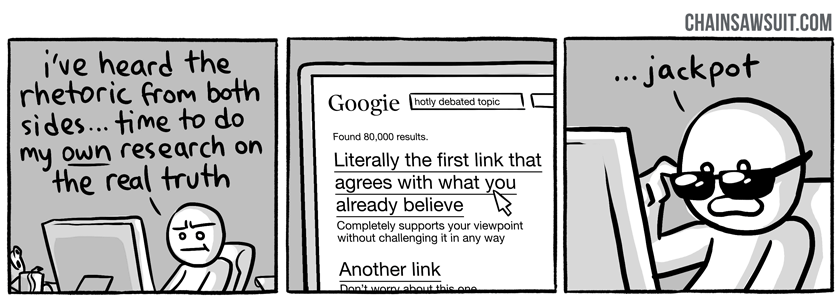
The confirmation bias afflicts us all.  We look for and rely on information and evidence that confirms what we already believe, and we avoid or discount data that may contradict our pre-existing positions and beliefs.   This bias leads to many flawed decisions, because we are not looking in a balanced way at the evidence.  How can managers counteract this pernicious decision-making trap?  Here are a few suggestions:
  1. Before you begin to analyze a problem, write down your pre-existing beliefs.  Then, make two lists - one of the evidence supporting your initial position, and other of the data that disconfirms your initial views.   Make sure that you find at least three significant pieces of disconfirming evidence.   
  2. Role play someone with a different pre-existing position.  Build a short presentation intending to persuade others of the validity of that position.  In so doing, you are forcing yourself to collect data that disconfirms your initial view.
  3. Assign someone on your team to collect and present disconfirming evidence. 
  4. As people to work in pairs as they conduct research on an issue, with the pairs created so as to connect people with different initial viewpoints.
  5. Write down a few of the key assumptions that underlie your beliefs and positions.  Then design a simple test or experiment to try to validate each assumption.