Showing posts with label smartphones. Show all posts

Tuesday, October 28, 2025

What's Good for Our Kids is Great for Us Too!

Source: theladders.com

If you have not read Jonathan Haidt's amazing book, The Anxious Generation, I highly recommend it. Haidt makes a great case for banning smartphones in schools. Now, many school systems have adopted his advice. Early results suggest that the policies are having a positive impact on learning. I do not allow phones in my university classroom, and I'm confident that removing this distraction improves our dialogue considerably.

If this smartphone policy is good for our kids, shouldn't it be good for us as well? In today's Wall Street Journal, Chip Cutter writes an article titled "CEOs Are Furious About Employees Texting in Meetings."  He writes:

A few weeks ago, Airbnb CEO Brian Chesky asked his top lieutenants to identify the problems they saw quietly plaguing the company. Chesky called it the “fester list.” One executive threw out an issue: Too many Airbnb employees weren’t present in meetings because they were checking their phones or laptops. “It’s a huge problem,” Chesky said. Then the chief had a realization. He was guilty of zoning out, too. “Sometimes I’m like, ‘OK, I heard it. I know what you’re about to say. I know the subject matter,’” Chesky said. “I text, but then people see me text, they text. This is a major societal problem.”

Cutter cites leaders from JP Morgan CEO Jamie Dimon to QXO CEO Brad Jacobs about the challenges of distraction during meetings.  Many leaders have become incredibly frustrated by the disconnected conversations, lack of collaboration, and poor listening occurring during meetings.  Of course, many of us would say that we turn to our phones because many meetings are long, dull, and boring.  However, we have ask ourselves:  Isn't that what our kids would say about classes in which they would love to use their phone?  Are we just rationalizing our use of phones during meetings in the same way students often do?  How about the "what if there is an emergency?" excuse?  Ask yourself: Just how many true emergencies do we experience in a week?  Moreover, we can easily set our phones such that people won't disturb us unless it is truly an emergency.   Yet, we choose not to do so.  I'm just as much of a culprit as many others I know.  

You can see the self-reinforcing mess we have on our hands.  We jump to our phone because a meeting is boring.  Then, because we are distracted and not listening actively to others, the meeting discussion drags on endlessly.  The collaboration breaks down, and we end up needing yet another meeting to get key matters resolved.  We have to break this endless unproductive loop.  Team leaders need to establish a new contract with their team members.  They will focus the meeting, tighten the agenda, and avoid repeated tangents.   In return, they ask that team members stay off their phones.  Try it out. See what happens.  My guess?  The results will be very positive, much as they are in schools.  

Friday, November 20, 2015

Market Share Does Not Equal Profitability

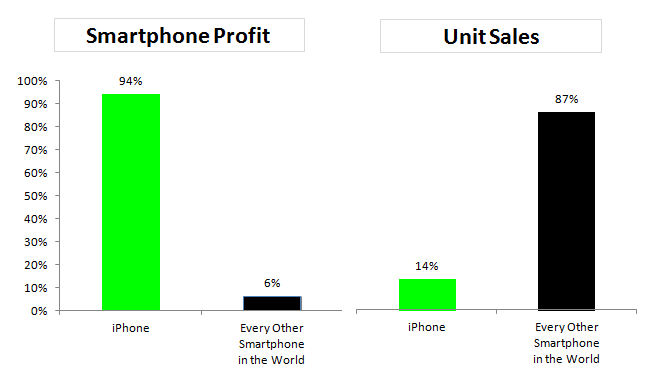
Over the years, I have stressed to students and executives that market share does not equal profitability in many cases.   Often firms set market share targets, and they become obsessed with being number one in share.  They forget that share is not always highly correlated with profitability.  My colleague, Lou Mazzucchelli, shared with me this incredible chart about smartphone sales that makes this point in a memorable and impactful way.  

Source:  Canaccord Research

Wednesday, June 22, 2011

Verizon to end unlimited data plans

Verizon appears ready to eliminate unlimited data plans from new offerings this summer. The move emulates rival choices made in the past year or so. Will unlimited data ever come back? Perhaps. Here is what one has to consider. The demise of unlimited data plans can be traced to two key events. First, the marginal cost of additional usage by the consumer is no longer necessarily zero. Remember that price falls toward marginal cost in hotly contested markets with high fixed costs and low marginal costs. Heavy usage can tax networks as we have seen, and video and other apps soak up bandwidth (meaning marginal costs do rise at some point). Second, recent consolidation means fewer rivals. With fewer competitors, the chances of maintaining this pricing increase goes up. With many rivals, the chances of some players cutting price (by offering unlimited plans) would be much higher.

Could unlimited plans return? Well, if the marginal costs of incremental usage go back toward zero as technology evolves and bandwidth increases, or if new entrants emerge, then we may indeed see them return.

Tuesday, June 07, 2011

Breaking Up Nokia?

Bloomberg BusinessWeek has conducted an interesting sum-of-the-parts analysis of Nokia.  The magazine argues that Nokia is worth more apart than it is together. Specifically, Bloomberg attempted to value the three major units of Nokia:  mobile phones, mapping systems, and infrastructure equipment.  It chose one comparable firm for each unit, and then valued the units based on the revenue multiples of the comparables.  The conclusion: Nokia's sum-of-the-parts may be worth 52% more than the whole! 

What should we make of this analysis?   I think it's certainly advisable for investors and executives to be looking at whether Nokia might be worth more in a break-up.  However, I have some concerns with concluding that the sum of the parts exceed the value of the current whole based on this methodology.   First, I would like to have seen some other valuation methods besides revenue multiples.  One wonders how much the numbers shift based on different valuation techniques.  Revenue multiples seem particularly troublesome here since the mobile phone unit seems in serious distress, with market share plummeting over the past few years as the smartphone business has been dominated by rivals such as Android and Apple. 

Second, the methodology only chooses one comparable for each Nokia business unit.  I would much rather see a set of comparables for each unit, with an average taken of the revenue or earnings multiples for those rivals. 

Third, sum-of-the-parts analyses can be a bit dangerous if significant synergies exist among the units, and if those synergies might be lost during a break-up.  I don't know enough about the intricacies of Nokia's business to determine the extent of synergies; the article at BusinessWeek.com does not mention synergies at all.  

Finally, the rapid significant decline in the mobile phone business at Nokia really does make valuation a challenge.  Projecting forward based on history can be difficult based on the deterioration happening in the business.  As one expert noted in the article, "“It’s hard to do a sum-of-the-parts analysis when the floor is falling out and you don’t know where the bottom is.” (Michael Liss, fund manager at American Century)