Showing posts with label active listening. Show all posts

Thursday, June 04, 2026

Are You Listening to Me? How Can I Tell?


Are you listening to me? This thought comes to mind for many of us during conversations. How can we tell that someone is listening? Conventional wisdom is that body language and non-verbal cues indicate attentiveness. Is the counterparty nodding in agreement, making good eye contact, and leaning forward into the conversation? If so, they must care about what I'm saying. If not, then they are clearly disengaged.

New research suggests that this conventional wisdom may not be right though. In an article from UCLA's Anderson Review, Carla Fried reviews a stream of research by Hanne Collins and several co-authors. This research finds that people systematically overestimate the extent to which others are listening closely to them. They overestimate because they misread utterances or nonverbal cues... they think that the quiet "mm-hmm" or the nod of agreement signal close listening, when they may not represent that at all. Listeners may be using these conversational devices to "fake" close listening.

Collins and her co-authors instead suggest "conversational listening" as the remedy. Much like a stream of other work, including a great book by Charles Duhigg, they suggest that listeners paraphrase what they have heard and ask for confirmation, ask clarifying questions, and refer back to points made earlier in the conversation as ways to engage more effectively in a conversation.  In short, you must speak, not remain silent, to listen effectively.   Of course, you can not speak too much.  Interrupting without the intention of understanding more effectively can be highly counterproductive. Collins and her co-authors write, "“Conversational listening is a key building block of human social functioning. Information transmission, interpersonal connection, conflict management, happiness — the key foundations of human flourishing — hinge critically on our ability to hear, understand and respond to others.”

Tuesday, December 02, 2025

Are Others Pretending to Listen to You?


We have been taught that active listening is key to effective communication and collaboration.  What, though, constitutes the most effective form of active listening?  Suppose that someone is making eye contact, affirming your statements with a few simple nods, and/or uttering "mm-hmm" after a key point or two.  Are they listening closely?  Or are they pretending to listen?   

It turns out that we are not always very good at discerning whether another party is listening closely or feigning attentiveness.   UCLA's Anderson Review recently spotlighted the research of Professor Hanne Collins and her colleagues, writing:  

A burgeoning area of study, with papers co-authored by UCLA Anderson’s Hanne K. Collins, is establishing that speakers who feel heard often are not; that when the spoken-to feign attentiveness, it’s highly effective at misleading a speaker; and that a more active listening mode — volleying back a bit of what you’ve heard, explicitly stating a desire to engage, especially on topics of a sensitive nature – is the path to a more effective sort of conversing.

Collins suggests that there are two forms of active listening.  In the simpler form, it involves non-verbal cues intended to suggest that you are paying close attention. In another form, you are engaging with the other party in a much more conversational form.  This latter form of active listening is much more effective, and it signals clearly that you are in no way feigning attentiveness.  Collins focuses on three types of interaction:
  • Paraphrasing: “Let me make sure I have this right. What happened at school today was…”
  • Conversational callbacks: “As you mentioned in your email last week, your team needs more support to complete this project on time.”
  • Follow-up questions: “I hear that you’re asking me to do more around the house. What specifically would help?”
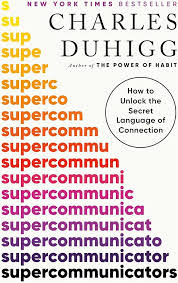
For more on how to have an effective dialogue that includes a healthy dose of active listening, I highly recommend Charles Duhigg's book, Supercommunicators: How to Unlock the Secret Language of Connection. 

Tuesday, October 28, 2025

What's Good for Our Kids is Great for Us Too!

Source: theladders.com

If you have not read Jonathan Haidt's amazing book, The Anxious Generation, I highly recommend it. Haidt makes a great case for banning smartphones in schools. Now, many school systems have adopted his advice. Early results suggest that the policies are having a positive impact on learning. I do not allow phones in my university classroom, and I'm confident that removing this distraction improves our dialogue considerably.

If this smartphone policy is good for our kids, shouldn't it be good for us as well? In today's Wall Street Journal, Chip Cutter writes an article titled "CEOs Are Furious About Employees Texting in Meetings."  He writes:

A few weeks ago, Airbnb CEO Brian Chesky asked his top lieutenants to identify the problems they saw quietly plaguing the company. Chesky called it the “fester list.” One executive threw out an issue: Too many Airbnb employees weren’t present in meetings because they were checking their phones or laptops. “It’s a huge problem,” Chesky said. Then the chief had a realization. He was guilty of zoning out, too. “Sometimes I’m like, ‘OK, I heard it. I know what you’re about to say. I know the subject matter,’” Chesky said. “I text, but then people see me text, they text. This is a major societal problem.”

Cutter cites leaders from JP Morgan CEO Jamie Dimon to QXO CEO Brad Jacobs about the challenges of distraction during meetings.  Many leaders have become incredibly frustrated by the disconnected conversations, lack of collaboration, and poor listening occurring during meetings.  Of course, many of us would say that we turn to our phones because many meetings are long, dull, and boring.  However, we have ask ourselves:  Isn't that what our kids would say about classes in which they would love to use their phone?  Are we just rationalizing our use of phones during meetings in the same way students often do?  How about the "what if there is an emergency?" excuse?  Ask yourself: Just how many true emergencies do we experience in a week?  Moreover, we can easily set our phones such that people won't disturb us unless it is truly an emergency.   Yet, we choose not to do so.  I'm just as much of a culprit as many others I know.  

You can see the self-reinforcing mess we have on our hands.  We jump to our phone because a meeting is boring.  Then, because we are distracted and not listening actively to others, the meeting discussion drags on endlessly.  The collaboration breaks down, and we end up needing yet another meeting to get key matters resolved.  We have to break this endless unproductive loop.  Team leaders need to establish a new contract with their team members.  They will focus the meeting, tighten the agenda, and avoid repeated tangents.   In return, they ask that team members stay off their phones.  Try it out. See what happens.  My guess?  The results will be very positive, much as they are in schools.  

Wednesday, May 14, 2025

How to be a Supercommunicator


Have you met someone who is a highly effective communicator who engages you in enjoyable and helpful conversations with ease?  Why are they so effective at making conversation?  Recently, I read Charles Duhigg's terrific book, Supercommunicators: How to Unlock the Secret Language of Connection.  Charles earned a Pulitzer Prize as a writer for the New York Times.  Many years ago, he was my student in the MBA program at Harvard Business School.  In Duhigg's book, he explores the behaviors and methods of people who are particularly effective at connecting with others.  When he published the book, Duhigg sat for an interview with McKinsey & Company.  He commented on one very important trait of supercommunicators: 

Supercommunicators ask ten to 20 times more questions than the average person. Those questions can include something like, “That’s interesting. What did you think of that?” or “What did you say next?” They pose questions that invite us into the conversation.  Some of their questions are “deep questions.” These questions ask people about their values, beliefs, or experiences. An example of this could be as easy as saying, “You’re a lawyer. What made you decide to go to law school?” They ask questions that dig into learning who people are. They aren’t overly intimate questions but an opportunity to share who we are. People love the opportunities to share those things, which could feel amazing.

Duhigg notes that supercommunicators also are very good at detecting the type of conversation in which others wish to engage.  Is it an emotional, practical, or social conversation?  Many people mistakenly approach all conversations as practical ones, i.e., we are trying to solve a problem together.  Sometimes, though, others do not want help coming up with a plan of action or making a decision.  Instead, they want to share how they are feeling and would like someone to simply listen and empathize.  In short, you have to understand the purpose of the conversation.  In other words, what does the other party want from the dialogue?  

Finally, Duhigg stresses one technique that is very helpful in any conversation.  The term for this approach is "looping for understanding."  Sometimes, people describe it as the "playback" method. When we engage in looping or playback, we are listening actively, restating what we believe we have heard, and then we seek confirmation from the other party.  In short, we ask: Did I understand you correctly?  That question enables others to clarify their thoughts and helps us avoid misunderstandings.   

Thursday, April 04, 2024

Be a Loud Listener


I'm looking forward to hearing David Brooks speak at my daughter's graduation from Vanderbilt University next month.   Brooks, a writer for the New York Times, has written a new book titled, " How to Know a Person: The Art of Seeing Others Deeply and Being Deeply Seen.  I'm reading the book now, and it has some terrific insights on how we can connect, empathize, and communicate with others more effectively.  Brooks appeared recently on Matt Abraham's podcast from Stanford.  Brooks introduces a very interesting concept.  He describes the value of being a "loud listener" when communicating with others:  

First, regarding attention, treat attention as an on off switch, not a dimmer. So, when you’re talking to somebody, it should be a hundred percent or zero percent. Don’t try to 60 percent it and have 40 percent of your attention on your phone. Be a loud listener, I have a buddy when you’re talking to him, it’s like talking to a Pentecostal charismatic church, he’s like, uh huh, yes, yeah, uh huh, amen, I preach, preach. I love talking to that guy. And some people are loud with their voices, some people are loud with their faces, they’re emotionally reacting. And so, I love talking to those people.

Brooks is emphasizing an important part of active listening.  It involves really showing the other person that you are paying attention.  You are truly leaning into the conversation when you are a loud listener.  Brooks also reminds us that we aren't very good at multitasking.  We have to give others 100% of our attention in a conversation, rather than trying to do two other things at the same time (which we all do, of course). 

Monday, February 01, 2021

Sharpening Your Active Listening Skills


The Center for Creative Leadership offers a concise description of six important active listening skills. Here's a quick summary:

1. Pay attention: Avoid distractions such as cell phones and laptops. Avoid interrupting the speaker. Maintain eye contact. Watch for body language that might signal your approval, disapproval, anger, etc. Take notes if necessary, but be sure not to bury your head in your notepad. Don't start thinking through your response while the other person is speaking.
 
2. Withold judgment: Try to put aside your own pre-conceived notions or positions on the issues at hand. Don't jump to conclusions until you've heard the entire explanation/argument. Identify some of your own assumptions, and be sure to acknowledge that these presumptions might not be valid. Treat your beliefs as testable hypotheses rather than settled truths.

3. Reflect: Paraphrase what you have heard periodically, and ask if you have understood the other party correctly.

4. Clarify: Ask questions to elicit further explanation. Start with open-ended questions. Follow up with clarifying and/or probing questions. Generally, you should avoid questions that simply require a yes/no answer. Refrain from posing the leading question. Seek to understand what the other party is feeling, not simply what they are thinking or saying (strive for empathy).

5. Summarize: Synthesize what you have heard periodically, and ask for confirmation of your understanding. Seek consensus on key points for future action or follow-up.

6. Share: Having sought to understand the other party, you can now try to share your own ideas and perspectives.

Tuesday, March 20, 2018

Should Leaders Speak Last in Meetings?

Canadian enterpreneur Cameron Herold argues in this article in the Globe and Mail that leaders should speak last in meetings.  He writes,

When you have quieter, more reserved people in a meeting, the best thing you can do as the leader is hold your ideas back until the end. Too often, leaders offer their ideas first. But people don't become confident, or grow as leaders, by listening to what you have to say. Instead, you need to encourage members of the team to offer their ideas first, especially those less inclined to speak up.

Herold makes a great point here.  I'm not suggesting that leaders should always speak last.  However, in many cases, the leader does need to exercise some restraint so as to insure that all voices will be heard.  Moreover, leaders frame the problem when they open the discussion.  How you frame a problem often drives the types of solutions that are generated.  Leaders need to be careful about not framing a problem in a way that constricts the alternatives that are put forth.  

What should a leader be doing if they are not putting forth their ideas and proposals at the outset of the meeting?  They should be listening actively, asking questions, probing assumptions, requesting additional data if necessary, and calling on those who may be quiet to encourage them to join the conversation.