Showing posts with label market share. Show all posts

Wednesday, September 20, 2017

Herb Kelleher on Market Share

Entrepreneur Joel Gascoigne tweeted a quote from Southwest Airlines co-founder Herb Kelleher yesterday. The quote describes Kelleher's views on the pursuit of market share vs. profitability. I think he's hit the nail right on the head.


Thursday, July 27, 2017

Bud Light's Decline: What's the Brand Promise?


The Wall Street Journal reports today that Budweiser and Bud Light continue to experience market share declines in the United States.   The chart shown here documents the eroding share over the past six years for the Bud Light brand.  The main Budweiser brand also has experienced share decreases over this time.  The article attributes the declines to the growing appeal of craft beers and imports.   The article makes me wonder about Budweiser and Bud Light's brand promise.  What is it, and has it been updated effectively for the current market environment. What is Bud selling these days, and has it positioned itself appropriately amidst the heightened competition from craft brews and imports?


Consider the concept of a brand promise.  What is a brand promise?   Hinge Marketing describes it as "the tangible benefit that makes a product or service desirable." Workfront defines it as " a value or experience a company’s customers can expect to receive every single time they interact with that company." Workfront argues that a highly effective brand promise has five attributes: simple, memorable, credible, different, and inspiring.  

Does Bud Light have a brand promise that meets these five criteria? Has it updated that brand promise for the current competitive situation and to meet today's customer needs and desires?  It's not clear to me that they have figured out how they should position themselves in this current environment.  

What's an example of a brand promise that does meet these five criteria?  How about Ritz Carlton?  Their brand promise is quite compelling:  "Ladies and gentlemen serving ladies and gentlemen."  


Friday, May 26, 2017

Why Being #1 Should NOT Be Your Goal

This morning Kathy Chu wrote a Wall Street Journal article titled, "China's Lenovo to Reboot  After Losing PC Crown to HP."   Chu writes:

China’s Lenovo Group is shaking up its operations as it seeks to reclaim the title of global leader in personal computers and shore up its smartphone business.   For the first time in four years, Lenovo—a company that gained acclaim a decade ago for turning around storied U.S. personal-computer maker International Business Machines Corp.—slipped from the top spot this year to No. 2 in the personal-computer market, behind rival HP Inc.  Lenovo has also fallen to No. 8 in the number of smartphones shipped globally, from No. 3 when it acquired another U.S. brand, Motorola, in late 2014.

When I read this article, I asked myself:  Why do firms obsess with being #1 in their market?  Or, perhaps more specifically, why do they obsess with being #1 in market share in their industry?  Yes, Lenovo held the top spot in the personal computer industry for the past four years.  What precisely did that mean for them?  Well, I checked their Annual Report.  Last year, the company reported a net loss.  During the previous year, they generated a slim profit (1.79% profit margin).    Before that, the margins ranged from 1.6% to 2.1% from 2012-2014.  In short, Lenovo has made very little money over the past five years.  Perhaps, you might argue, they generated a decent return on assets despite the low margins.  With strong asset turnover as a low cost producer, they might produce a good return on assets.  Not so much... in 2015, their ROA equaled 3%.   We should not be surprised by these results.  It's not necessarily an indictment of management.  The personal computer industry is one of the lowest profit industries on earth.  If you perform a five forces analysis, you conclude rather quickly that all the elements of the industry structure point to low returns.  It's a very unattractive industry.  

The lesson: Don't obsess over market share.  Don't worry so much about being #1 in volume.  Think instead about the structure of your industry.  If you are in an unattractive industry, you might not want to be #1 in market share. Instead, you may want to find profitable niches and segments within that industry.  By focusing there, you might not lead the industry by volume, but you may produce stronger returns for investors.  

Wednesday, April 27, 2016

Is Market Share a Useful Metric?

In a short article for Sloan Management Review, Neil T. Bendle and Charan K. Bagga argue that managers should be cautious about using market share as a key metric for their businesses.  I concur wholeheartedly with their concerns about using market share as a primary objective.  I believe that efforts to grow market share often cause managers to pursue misguided strategies that ultimately undermine competitive advantage and damage long-run profitability.   Bundle and Bagga argue:

In some markets, bigger can be better; the most obvious examples are markets with economies of scale. Companies in such markets can reduce their cost per unit by selling more — thus increasing overall profits. If you think you are in such a market, you should confirm that the economies of scale you think exist actually do. Economies of scale do not automatically apply to all markets. For example, consulting does not get substantially cheaper per hour to provide at higher volumes... In some settings, market share can be a proxy for power. Depending on the setting, relative size can matter, and having a bigger market share can encourage others to treat your company more favorably. For example, when it comes to dealing with retailers, a category leader such as Coca-Cola may be able to negotiate better deals than a weaker brand can; retailers need Coke on their shelves more than they may need a smaller brand. A similar logic applies to network goods, which are products for which the benefit to consumers increases when more people use them. For example, Facebook’s value to its members increases when more of its members’ friends use it. Overall, though, the research on the relationship between profits and market share is ambiguous. There is no general rule; the importance of market share varies from market to market.

Friday, November 20, 2015

Market Share Does Not Equal Profitability

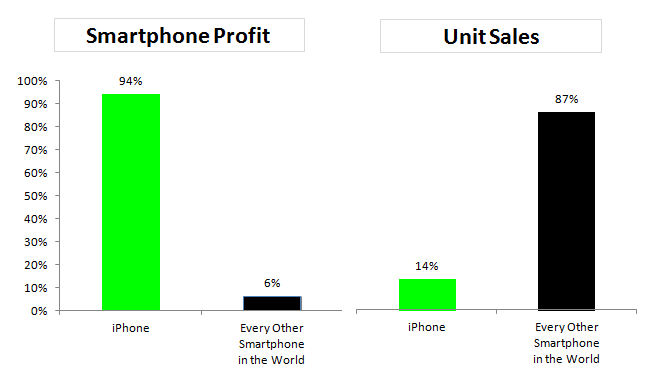
Over the years, I have stressed to students and executives that market share does not equal profitability in many cases.   Often firms set market share targets, and they become obsessed with being number one in share.  They forget that share is not always highly correlated with profitability.  My colleague, Lou Mazzucchelli, shared with me this incredible chart about smartphone sales that makes this point in a memorable and impactful way.  

Source:  Canaccord Research

Wednesday, September 23, 2015

The Volkswagen Scandal: The Perils of Trying to be #1

Yesterday we learned that Volkswagen employed software specifically designed to circumvent emissions regulations.  When I heard the news, I began to think about several recent scandals in the automotive industry.   GM had the ignition switch scandal.  Toyota had the acceleration problems.  Now Volkswagen has acknowledged to tampering with technology to make it appear as though emissions were lower than they actually were.  What do all three firms have in common besides these unfortunate failures?   At one point or another over the past fifteen years, each firm has aspired to be the largest automotive company in the world.   Each company aimed to achieve the number one position in terms of market share.  I cannot help but think that such aspirations contributed to the problems that have surfaced.   Becoming number one in market share should never be the goal of a firm.  They should be striving to achieve solid returns for their shareholders, exceed the expectations of their customers, become a responsible corporate citizen, etc.   Market share should not be the ultimate goal.   What's the downside of trying to be number one in market share?  It means that you may grow faster than you are capable of growing.  You may create an organization that is too large and complex to manage effectively.   You may overlook issues and problems in an effort to grow.  I'm not saying that aspiring to have leading market share is the only cause of these scandals.  Of course, many other factors contributed to this behavior.  However, I do think these scandals illustrate how trying to be the biggest can have pernicious unintended consequences. 

Wednesday, June 29, 2011

Did Focus on New Growth Opportunities Hurt the Core at Pepsi?

Yesterday, the Wall Street Journal ran an interesting set of articles about recent changes at Pepsi.  The articles question whether PepsiCo CEO Indra Nooyi's attention on new growth opportunities, particularly in healthier foods and beverages, may have damaged the core business.   According to the Wall Street Journal, U.S. sales of Pepsi and Diet Pepsi fell by 4.8% and 5.2% last year, while Coke's comparable brands lost only 0.5% and 1.0% share respectively.    Moreover, Diet Coke passed Pepsi as the #2 soft drink brand in America.   The article points out that Nooyi scaled back advertising on the core Pepsi brand fairly significantly over the past few years, and it suggests that this move may have affected market share.   Here's one excerpt from the article:

Jim Tierney, chief investment officer at W.P. Stewart, says PepsiCo focused too much on redesigning Pepsi's logo and the Refresh Project instead of spending money on more traditional advertising.
"You just can't go dark on brands and expect them to hold their value,'' said Mr. Tierney, who is a bigger fan of the company's snack business. 

One can certainly debate the reasons for Pepsi's market share declines.   Changes in packaging and other moves certainly also had an effect.   In one of the articles, Nooyi defends her actions, suggesting that she by no means has downplayed the importance of the core Pepsi brand in her strategy.  

One cannot debate the broader lesson here though, even if Pepsi's issues aren't simply due to the focus on new growth areas in "good for you" brands... many companies do get themselves into trouble when they try to grow in adjacent markets.  Why?   The efforts to grow distract management attention and draw resources away from the slow-growing core.  As a result, however, the core suffers even more than it should due to broader external trends.   The key issue is that it's not simply about financial resources.  Even if the core continues to get its share of money, it may not be getting the ATTENTION of key executives, and perhaps not even attracting the most talented, entrepreneurial individuals at times.