Showing posts with label conversation. Show all posts

Thursday, June 04, 2026

Are You Listening to Me? How Can I Tell?


Are you listening to me? This thought comes to mind for many of us during conversations. How can we tell that someone is listening? Conventional wisdom is that body language and non-verbal cues indicate attentiveness. Is the counterparty nodding in agreement, making good eye contact, and leaning forward into the conversation? If so, they must care about what I'm saying. If not, then they are clearly disengaged.

New research suggests that this conventional wisdom may not be right though. In an article from UCLA's Anderson Review, Carla Fried reviews a stream of research by Hanne Collins and several co-authors. This research finds that people systematically overestimate the extent to which others are listening closely to them. They overestimate because they misread utterances or nonverbal cues... they think that the quiet "mm-hmm" or the nod of agreement signal close listening, when they may not represent that at all. Listeners may be using these conversational devices to "fake" close listening.

Collins and her co-authors instead suggest "conversational listening" as the remedy. Much like a stream of other work, including a great book by Charles Duhigg, they suggest that listeners paraphrase what they have heard and ask for confirmation, ask clarifying questions, and refer back to points made earlier in the conversation as ways to engage more effectively in a conversation.  In short, you must speak, not remain silent, to listen effectively.   Of course, you can not speak too much.  Interrupting without the intention of understanding more effectively can be highly counterproductive. Collins and her co-authors write, "“Conversational listening is a key building block of human social functioning. Information transmission, interpersonal connection, conflict management, happiness — the key foundations of human flourishing — hinge critically on our ability to hear, understand and respond to others.”

Wednesday, April 22, 2026

How to Make Small Talk Effectively


Some people dread small talk. They just want to get on with the business at hand.  Why bother with the chit-chat about the weekend, the kids, or last night's episode of Rooster?  Research, however, demonstrates that small talk has value, helping us build relationships that facilitate more effective collaboration.  Moreover, small talk can enhance well-being.  

In a recent Inc. article, Henna Pryor speaks with writer Amaya Nichole about how to engage in small talk effectively.  Pryor offers three important and useful tips:

1. Focus on a specific detail.  It might be the photo on their desk, the screensaver on their computer, or the recent family celebration you know they attended.  Direct their attention, show them that you noticed, and inquire to learn more about that particular topic.

2.  Ask specific questions, rather than general ones.  Don't just ask how they are doing. Ask about a specific book, podcast, or TV show that they are enjoying.  Don't just ask how the family is doing, but inquire about a particular individual and a recent important event (birthday, graduation, wedding, etc.).  

3.  Finally, Pryor recommends that we "learn to leave a conversational thread."   Pryor offers an example of how to do this effectively: "This is less about the question asked and more about the response. Instead of answering 'how was your weekend?' with 'good,' try: 'It was good. It was really good. I finally checked out that new bookstore downtown and ended up staying for two hours. I did not need that many books.'"  

Wednesday, May 14, 2025

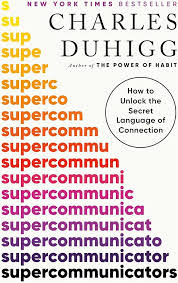
How to be a Supercommunicator


Have you met someone who is a highly effective communicator who engages you in enjoyable and helpful conversations with ease?  Why are they so effective at making conversation?  Recently, I read Charles Duhigg's terrific book, Supercommunicators: How to Unlock the Secret Language of Connection.  Charles earned a Pulitzer Prize as a writer for the New York Times.  Many years ago, he was my student in the MBA program at Harvard Business School.  In Duhigg's book, he explores the behaviors and methods of people who are particularly effective at connecting with others.  When he published the book, Duhigg sat for an interview with McKinsey & Company.  He commented on one very important trait of supercommunicators: 

Supercommunicators ask ten to 20 times more questions than the average person. Those questions can include something like, “That’s interesting. What did you think of that?” or “What did you say next?” They pose questions that invite us into the conversation.  Some of their questions are “deep questions.” These questions ask people about their values, beliefs, or experiences. An example of this could be as easy as saying, “You’re a lawyer. What made you decide to go to law school?” They ask questions that dig into learning who people are. They aren’t overly intimate questions but an opportunity to share who we are. People love the opportunities to share those things, which could feel amazing.

Duhigg notes that supercommunicators also are very good at detecting the type of conversation in which others wish to engage.  Is it an emotional, practical, or social conversation?  Many people mistakenly approach all conversations as practical ones, i.e., we are trying to solve a problem together.  Sometimes, though, others do not want help coming up with a plan of action or making a decision.  Instead, they want to share how they are feeling and would like someone to simply listen and empathize.  In short, you have to understand the purpose of the conversation.  In other words, what does the other party want from the dialogue?  

Finally, Duhigg stresses one technique that is very helpful in any conversation.  The term for this approach is "looping for understanding."  Sometimes, people describe it as the "playback" method. When we engage in looping or playback, we are listening actively, restating what we believe we have heard, and then we seek confirmation from the other party.  In short, we ask: Did I understand you correctly?  That question enables others to clarify their thoughts and helps us avoid misunderstandings.