 |
| Source: NBC Sports |
When organizations struggle and falter, they often look to the outside for new leadership. They hire CEOs from companies that they consider to be top notch. If the firm has excelled, then presumably, it has star members of the C-suite who could make terrific CEOs elsewhere. So goes the logic. Of course, we know that these outside hires don't always work out. The question is why.
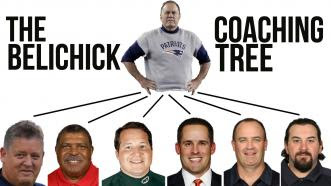
I've been thinking about this topic over the past few weeks, as we have witnessed a number of National Football League teams fire their head coaches. Among these firings, two more of New England Patriots' head coach Bill Belichick's proteges lost their jobs as head coaches of other teams. Observing these dismissals, I decided to compile the NFL win-loss record of all of Belichick's former assistant coaches during his time as the boss in New England: 175 wins, 252 losses, and 1 tie for a winning percentage of 40.9%. That's awful. Only one of his former assistants managed to compile a winning record (Bill O'Brien with 52 wins and 48 losses).
Why have Belichick's proteges failed so miserably? Several hypotheses come to mind.
1. The most obvious conclusion: None of these assistants had Tom Brady as their QB! As we all know, even Belichick has a losing record as a coach without Brady. More generally, these proteges didn't have all the other talent that accompanied Brady in New England. University of Texas coaching legend Darrell Royal once said, "It's not about the X's and the O's, but the Jimmys and the Joes." In other words, perhaps we overrate coaching and don't attribute enough of team success to the players themselves. In corporate terms, perhaps we place too much credit for success at the feet of a few top executives at successful firms and forget about the impact of many others supporting them.
2. Some of these proteges try to copy the Belichick style and system in its entirety rather than adapting to the new situation in which they find themselves. Moreover, these proteges attribute the Patriots' success to some factors that are not, in fact, the primary drivers of the team's high performance. Kalyn Kahler wrote an article for the Bleacher Report two years ago titled,
"When the Patriot Way Goes Wrong." She wrote:
"Listen, we all want to replicate the Patriots' success, but the track record of guys that come out and seem to try to replicate it is tough among front office and coaches," says another source, who has interviewed coaching candidates coming from New England, including Patricia. "Authoritarian, very hierarchical organizations, whether they are in football or otherwise, that's what you get: You don't get people to develop their own way.... "There is a sort of skepticism when people interview people coming out of New England," the source who has interviewed Patriots coaches, including Patricia, says. "Some of the New England ways have been so draconian. ... The league does look at those experiences and say, 'Are these guys trying to replicate a really, really difficult model to replicate?' It is certainly a focus when you talk to those prospects."
Many business leaders make the same mistake. They try to import the exact methods and techniques to which they attribute their former organization's success. They fail to assess the situation and adapt accordingly.
3. Many of these proteges had little or no professional football experience outside of working for Belichick in New England. Therefore, they did not have a solid understanding of how different his methods were from those to which other players and coaches were accustomed. A incomplete appreciation of the culture of other organizations left them ill-prepared to take over another team. Business leaders fall into the same trap if they take on a CEO role after spending their entire career in one organization (think about some of the former GE executives who stumbled elsewhere).
4. Perhaps these Belichick proteges believed that the Super Bowl rings on their finger would automatically generate buy-in and commitment on the part of the players on their new teams. However, it doesn't work that way. Yes, people will respect your past success, but you still have to build buy-in from the ground up. You have to cultivate trust and respect. Moreover, you have to convince players that the methods are key to winning. They aren't stupid. They see Tom Brady on the Patriots and think, "Are these dictatorial methods really the path to winning, or were those rings simply a result of having the greatest QB of all time?" Rightly or wrongly, that's the way some will think. Business leaders face similar challenges when they switch organizations. Employees will quickly tire of hearing that certain methods "worked before in my prior organization and can work again here."
5. Finally, one has to consider the impact that Belichick's hands-on style may have on the development of talent in his organization. Note that Belichick's mentor, Bill Parcells, has had a coaching tree that has been far more successful (Belichick, Tom Coughlin, Sean Payton, etc.). Similarly, Tom Landry and Bill Walsh had incredibly successful coaching trees. Does the way that those coaches led their teams matter? Perhaps they delegated more effectively, and in so doing, they developed the coaching talent around them more successfully. Understanding the leadership style of a person's former boss may be critical as you hire C-suite executives from another firm. Did the person work for a micromanager, and as a result, are they as prepared to make decisions on their own as you would like them to be?

