Tuesday, October 27, 2015

Do Firms Really Value Curiosity?

George Mason University Professor Todd  Kashdan has conducted a study about curiosity in the workplace.  He found that companies talk a good talk about curiosity and new ideas, but they don't walk the walk.   Kashdan reports, "Surveying workers in 16 industries, we found that while 65% said that curiosity was essential to discover new ideas, virtually the same percentage felt unable to ask questions on the job. The contradictions continued: while 84% reported that their employers encouraged curiosity, 60% said they had also encountered barriers to it at work."  

What types of barriers do workers cite?  According to Kashdan, "Common stumbling blocks cited (across industries) were a top-down approach to decision-making, limited time for creative thinking, a preference for safe ideas over new ones, and fear of standing out from the pack. How can these and other organizations do better?"  

We have seen the many reports about low employee engagement across a variety of industries and firms.  Why is engagement so low in the American workforce?  One reason may be that employees have become disenchanted by too many instances of leaders talking a good game, but not acting in ways that are consistent with those verbal messages.  Not backing up your words with actions can be a very easy way to lose the trust of your employees.  The research here on curiosity offers one example of a situation in which firms and their leaders appear to be dropping the ball. 


Thursday, October 22, 2015

Lessons from the Cuban Missile Crisis

Source:  Boston Globe (from JFK Library)
On this day in 1962, President John F. Kennedy addressed the nation to discuss the Cuban Missile Crisis.  In his speech, Kennedy informed the public that the U.S. would be establishing a naval quarantine around the island of Cuba until the missiles were removed.  I have written extensively about Kennedy's decision-making process during the crisis.   Ten years ago, I had the opportunity to talk to Kennedy's Secretary of Defense, Robert McNamara, about the crisis.  He came to Harvard to address my students at that time.  For more on what we can learn from how Kennedy led his team through that ordeal, you might wish to read an article that I published in the Ivey Business Journal.  

Wednesday, October 21, 2015

When You Are Overly Dependent on One Product: Apple's "Problem"

The Wall Street Journal has a great chart today (shown here) that highlights how increasingly dependent Apple has become on the iPhone as the one product driving a substantial portion of revenue and profit.   Many analysts have expressed concern about this dependency.  I find it an interesting discussion.  On the one hand, it does appear worrisome to have so much of the company's fate reliant on one particular blockbuster product. On the other hand, a firm has to be careful how it responds to this type of "problem" that emerges with success.  Diversifying recklessly simply to reduce dependency on a single product can be a recipe for disaster...yet many firms have made that mistake when faced with this situation.  Moreover, we know that focus can be a powerful dimension of any strategy.  Jobs preached focus relentlessly during his time at Apple (and at Pixar).   Will a company lose focus if it tries "too hard" to reduce reliance on one hit product?  It's a delicate balancing act, and it will be interesting to see how Apple navigates this situation in the years to come. 


Tuesday, October 20, 2015

Amazon Hits Back at The New York Times: Why Now?

Yesterday, Amazon's Jay Carney (former White House Press Secretary) published a post on Medium that criticized the New York Times scathing article published two months ago about Amazon's culture and workplace environment.    The newspaper offered a quick rebuttal.   My question: Why now?  Why offer this rebuttal two months after the article ran?  The controversy had died down, after receiving a great deal of attention two months ago.  Why bring the issues back to the forefront now?  It only serves to remind people about the negative statements and observations made about Amazon's organization.  Moreover, as The New York Times stated, the Carney post did not refute the claims made in the article directly, but instead only pointed out that some of the quotes came from highly disgruntled employees (at least one of whom may have been fired for wrongdoing).   In a situation such as this one, offering a clear rebuttal may be good policy, but timing is important.  You have to move quickly.  In many ways, you only rekindle the controversy by responding now.

Monday, October 19, 2015

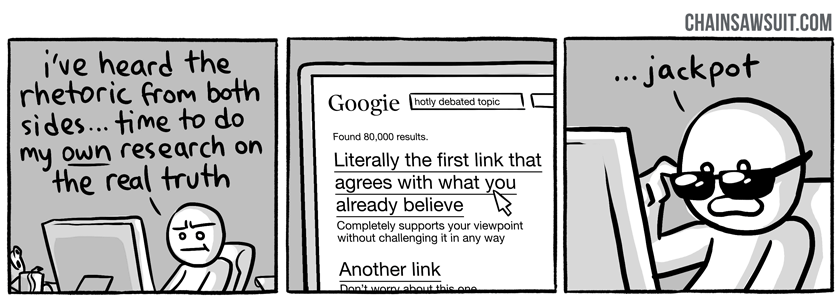
Confirmation Bias

I discovered this terrific comic about confirmation bias today.  
https://pbs.twimg.com/media/ByFacoMIcAA2roX.png:large

Normalization of Deviance at Volkswagen?

Paul Kedrosky, a venture investor, wrote a very interesting column for The New Yorker about the Volkswagen scandal.  He does not introduce new facts, but instead speculates as to how the ethical and legal transgressions may have taken place.  He draws upon Diane Vaughan's great work on the Challenger space shuttle accident.  In her research, Vaughan describes a phenomenon that she calls the "normalization of deviance."  It's a process whereby we gradually engage in riskier behavior.  We don't jump over the line from legal/ethical to illegal/unethical.  Instead, we inch our way there over time.  As Vaughan puts it, "the unexpected becomes the expected becomes the accepted" over time.  In short, what may look very risky or irresponsible in hindsight actually came to be viewed as acceptable  by decision makers in a gradual process that unfolded over a lengthy period of time.  With each incremental step down the slippery slope, people established a "new normal."  The next deviation didn't seem so large, because it wasn't being compared against the original standard of behavior.  Instead, it was being compared against the new normal established in the recent past.  Kedrosky explains how the normalization of deviance may have played out at Volkswagen.  Investigators should definitely examine this aspect of organizational behavior.  In no way does this explanation excuse the behavior, but it does help us understand how such things happen in large organizations.  Here's Kedrosky's hypothesis:

If the same pattern proves to have played out at Volkswagen, then the scandal may well have begun with a few lines of engine-tuning software. Perhaps it started with tweaks that optimized some aspect of diesel performance and then evolved over time: detect this, change that, optimize something else. At every step, the software changes might have seemed to be a slight “improvement” on what came before, but at no one step would it necessarily have felt like a vast, emissions-fixing conspiracy by Volkswagen engineers, or been identified by Volkswagen executives. Instead, it would have slowly and insidiously led to the development of the defeat device and its inclusion in cars that were sold to consumers... Faced with an expensively engineered diesel engine that couldn’t meet strict emissions standards, Volkswagen engineers “tuned” their engine software. And they kept on tuning it, normalizing deviance along the way, until they were far from where they started, to the point of gaming the emissions tests by detecting test conditions and re-calibrating the engine accordingly on the fly.

Thursday, October 15, 2015

The Inbev Acquisition of SAB Miller

Major consolidation in the beer industry continued this week, as Inbev agreed to acquire SAB Miller for over $100 billion.  The deal continues a long track record of acquisition by Inbev.  Several years ago, they took over Anheuser Busch, for instance.   Here are a few thoughts about this deal, with lessons that apply to many mergers and acquisitions:

1.  Divestitures of certain brands are highly likely due to antitrust concerns.  Therefore, other major brewers could be able to acquire some important brands during this process. 

Broader lesson:  Will rivals be strengthened at all as a result of an acquisition that we do? 

2.  Economies of scale and scope are a major driver of beer industry consolidation.  However, one has to ask:  How big is big enough?  At what point do diseconomies kick in?  Moreover, some research suggests that economies of scale in the beer business are largely about achieving scale within a particular country as opposed to achieving global scale. 

Broader lesson:  How confident are we that diseconomies of scale will not hamper us?

3.   Acquisition integration will be challenging, as with many complex cross-border deals.  The firms will have to account for "anti-synergies" i.e. the costs associated with trying to put the two firms together and achieve synergies.  Put another way,  many deals include detailed valuations of potential synergies without examining the true cost of putting in place processes and systems to achieve those economies of scope.

Broader lesson:  Value synergies and anti-synergies in every deal you make.

4.  Cost synergies are easier to achieve than revenue synergies.  They are much more concrete and predictable.  Inbev has a great history of achieving cost synergies.  To really make this deal worthwhile, they will have to drive revenue synergies as well.

Broader lesson:  Is your deal based on the somewhat hard-to-quantify hope and promise of revenue synergies or the more concrete and predictable cost synergies of bringing two firms together?

Tuesday, October 13, 2015

Was Steve Jobs' Daily Question to Jony Ive a Good One?

Inc. magazine reports this week on the one question that Steve Jobs asked Apple design guru Jony Ive every day.  Here's the query:  "How many times did you say no today?"   Jobs preached "extreme, laser-like focus" at all times. Ives explained:   "The discipline to turn your back on something you believe in passionately, so you can apply yourself to what's at hand, is really remarkable," Ive said. "It's a deeply uncomfortable but really effective thing to do."  

Do I agree with Jobs' question?  All things in moderation, I suppose.   I do agree that focus is crucial if you want to excel.  That's as true of companies as it is of individuals.  Great firms clearly make tradeoffs; they say no when the typical firm in their industry says yes.  Trader Joe's, for instance, rejects many of the standard ways of doing business in the grocery industry.  That makes them incredibly distinctive and difficult to imitate. 

When it comes to individual behavior, though, I am a little leery of taking the Jobs question too far. To have a successful organization, we have to have people who are willing to sacrifice at times to help others. We need collaborators.  That means sometimes saying yes for the good of the greater whole, even if it may distract you from the task at hand.  

Friday, October 09, 2015

Quick Tip for New Hires

You have landed a new job, perhaps just out of college or maybe after a successful stint at another organization.  You have lofty ambitions for your career.   People have advised you to find a mentor to help you think about your long term goals and objectives.  Hold it!  Before you go any further, here's an important tip offered to me by a mentor many years ago.  He reminded me before I started work, "Do the job that you have been assigned.  Do it well.  The best thing you can do for your long term career goals is to excel at your current assignment.  Don't put tomorrow before today."   It was tremendous advice.  I encourage everyone to follow it. 

More on Making Good Predictions: An Interview with Philip Tetlock


Thursday, October 08, 2015

Delivering Bad News: The Message, the Messenger, and the Masses

Mark Cotteleer of Deloitte Research and his colleague Timothy Murphy have written a great piece about the delivery of bad  news in organizations.   As Colin Powell once said, "Bad news isn't wine.  It doesn't improve with age."  However, in many organizations, bad news fails to surface in a timely manner.   Cotteleer and Murphy examine this issue and offer a simple framework for thinking about it. They focus on the message, the messenger, and the masses.   With regard to the message, Cotteleer and Murphy argue that, "To protect one’s self from the stress of delivering bad news, one may communicate in ways that help the recipient to avoid, distort, or ignore the bad news."  With regard to the messenger, they argue that bad news is more likely to be heard and attended to if the messenger has a specific role/responsibility for project oversight.  If they don't have that type of designated role, they are less likely to be heard.  Finally, with regard to the masses, they argue that a small bit of "sugarcoating" can actually be beneficial.  Unfortunately, many organizations take that too far, downplaying serious risks at times.  

In my own work (Know What You Don't Know, 2009), I've examined the issue of surfacing bad news proactively.  In this excerpt, I explain why problems often remain hidden in organizations:

First, people fear being marginalized or punished for speaking up in many firms, particularly for admitting that they might have made a mistake or contributed to a failure. Second, structural complexity in organizations may serve like dense “tree cover” in a forest, which makes it difficult for sunlight to reach the ground. Multiple layers, confusing reporting relationships, convoluted matrix structures, and the like all make it hard for messages to make their way to key leaders. Even if the messages do make their way through the dense forest, they may become watered down, misinterpreted, or mutated along the way. Third, the existence and power of key gatekeepers may insulate leaders from hearing bad news, even if the filtering of information takes place with the best of intentions. Fourth, an over-emphasis on formal analysis and an under-appreciation of intuitive reasoning may cause problems to remain hidden for far too long. Finally, many organizations do not train employees in how to spot problems. Issues surface more quickly if people have been taught how to hunt for potential problems, what cues they should attend to as they do their jobs, and how to communicate their concerns to others.

Tuesday, October 06, 2015

Superforecasters: Foxes vs. Hedgehogs

You can't go anywhere, watch anything, or read any article these days without hearing from an expert or pundit predicting the future.  Should we pay much attention to those forecasters?  Well, according to research by Philip Tetlock and his fellow scholars at the Good Judgment Project, we might want to remain skeptical of such predictions.   They have found that many experts are not very accurate in their predictions.  On other hand, they discovered some folks who they term "superforecasters."  Who are these folks?  Here's an excerpt from a BBC story on Tetlock's research:

Roberts cites the Isaiah Berlin essay “The Fox and the Hedgehog” – a comparison often used by Tetlock himself – which divides thinkers into those “hedgehogs'” narrowly invested in a single topic and “foxes” with a wider, if shallower, range of experience. “Foxes” like him, Robert says, tend to be better forecasters. “They don't get attached to one particular narrative” and are able to adapt their viewpoints to incorporate any new information, unlike “hedgehog” thinkers, who often force new information into a pre-existing mental framework, or discard it if it seems to contradict their initial view.

In short, the problem with many experts is that they are hedgehogs.  They have deep expertise in a narrow domain, but as a result, they also have a lot of biases.   They have a strong attachment to certain pre-existing beliefs.  The foxes are more open-minded.  What else characterizes the superforecasters?
1.  An ability to ask good questions
2.  An ability to assimilate new information, even if it contradicts their initial view
3.  An ability to use the scientific method to pose and test hypotheses
4.  A reliance on data and not just intuition
5.  A willingness to acknowledge their own lack of knowledge in certain areas 

Rebranding Yourself Mid-Career

In this terrific brief video, Duke Professor Dorie Clark describes how one should tackle a mid-career transition, with a focus on re-positioning your personal brand.


Monday, October 05, 2015

Why Do Successful People Celebrate Their Failures?

Harvey Deutschendorf asks an interesting question in a new Fast Company article:  Why do successful people enjoy celebrating their failures?  He argues that our culture has created a mystique around failure.   Success comes from hard work, from perseverance, from not giving up even when  you stumble.  Of course, success can, in part, also be attributed to good fortune, a combination of the right circumstances at the right time.  Success can derive from having the right team coming together to collaborate with and support you.  However, we don't want others to underestimate the effort required to succeed.   We don't want them to attribute our successes to luck.  Thus, we enjoy telling the tales of our struggles, of the failures that we had to overcome in order to achieve the ultimate positive result.    

There's nothing wrong with this attitude actually.  In fact, reminding others of the importance of learning from failure is beneficial.  Moreover, it's useful to encourage others to experiment, and to accept that failure is part of the innovation process.  The only downside of such stories emerges if we underestimate the role of others in our success, as well as the role of circumstances and other environmental factors.  If we begin to believe that success is all about us, then we may be setting ourselves up for future failures. 

Saturday, October 03, 2015

Sbarro: In Strategy, You Have to Choose

The Wall Street Journal reports today on yet another reorganization at Sbarro, the operator of Italian eateries in malls throughout the US.  Sbarro has already experienced two bankruptcies in its history.  What's the new plan for turning around the company?  They will open neighborhood pizza shops with dine-in, take-out, and delivery options for consumers.  They will focus on pizza.  The firm argues it has suffered in recent years due to substantial declines in mall traffic.  Ok, the strategy sounds readonable so far.  However, then you read that the CEO believes that there is still an opportunity to add mall food court locations.  Huh?  He says, "There are 900 malls in the US with food courts, and we're in a third of them.  But instead of them representing 90% of our sites, I'd like them to represent less than half."

The question, though, is whether a company with limited resources and a history of financial troubles can do multiple things at once. Are the two business models (malls vs stand-alone) fundamentally different? Can you optimize both?  Many companies fail because they simply cannot make tough choices about what to do and what not to do. Sbarro may succeed, but it might increasing its odds by making a choice about what it really wants to be.  Instead, it appears to be falling into the trap of seeing a large market (malls) and not being willing to walk away.  However, it shouldn't fixate simply on the size of that market.  It should consider whether it can run mall and stand-alone businesses efficiently together.  

Wednesday, September 30, 2015

Why We Might Want to Meet Face-to-Face

Laura Vanderkam has written a good article for Fast Company about the value of face-to-face communication.  She examines the science behind why in-person communication may be more beneficial than virtual meetings at times. 
 
Vanderkam points to one particularly interesting study by Juliana Schroeder, Jane Risen, Francesca Gino, and Michael Norton. They found that, "Handshakes are particularly consequential nonverbal gestures in negotiations because people feel comfortable initiating negotiations with them and believe they signal cooperation." The scholars discovered that handshakes lead to more cooperation in a negotiation. That collaboration helps people grow the pie, i.e. achieve potential win-win outcomes. Moreover, the handshake led to more honest behavior. People were less likely to lie about their interests after exchanging a handshake with another party. 

Vanderkam points out several other benefits of face-to-face communication.  You can read nonverbal cues more easily, and frankly, you are more attentive as it becomes much more socially awkward/inappropriate to multitask in person.  In other words, you are simply less likely to look at your laptop, tablet, or phone if you are in a face-to-face meeting than in a virtual setting. 

Tuesday, September 29, 2015

The Personal Invitation

You would like people to attend your meeting, conference, reception, or other event.  You prepare a written invitation, and you distribute in electronic form and perhaps in hard copy as well.  You don't get the type of response you would like.  Why not?  Here are three reasons:

1.  The invite was not personal.  Consider reaching out personally to some key people and ask them to invite others personally.  That direct touch still matters, even in this electronic age. 

2.  You didn't answer the question: What's in it for me?  You have to demonstrate or explain why there's value for them in attending. 

3.  You failed to focus enough on who else will be there.  People want to know if key peers will attend as well.  They want to be able to connect, communicate, and learn from them.  Yes, we all still act like high school students.  We want to know who else is going before we join the party. 

Friday, September 25, 2015

The Final Interview Question

We've all faced that final job interview question: Do you have any questions for me?  We've heard the advice.  Be sure to ask questions that show you have done your homework about the organization.  I agree completely.  I think another question is equally crucial: If I joined the firm, what do you think a successful first year would look like?  What would we have accomplished?  That question can really help you determine whether their expectations are reasonable, and whether you have the capabilities to meet those expectations.  You can also get a sense of the culture.  Did they respond by simply citing some metrics you must achieve, or did they talk about building relationships, developing a team, etc.?  If different interviewers give you radically different answers to this question, it tells you the organization is not on the same page about this role.  That's not good news.  

Thursday, September 24, 2015

How Could the Volkswagen CEO Not Know About the Emissions Issue?

Martin Winterkorn resigned as chief executive of Volkswagen yesterday, after a major scandal rocked the company.   The company has admitted to manipulating technology to dodge emissions regulations.  Winterkorn continues to insist that he didn't know anything about the impropriety, though he did take responsibility and step down as chief executive.  Could it be possible that he didn't know?  Some would say that he must have known.   Naturally, we have no idea whether he's telling the truth.  We will have to wait for a full investigation to be completed.  However, I would like to suggest that it is possible that Winterkorn did not know.   Why?  Volkswagen, like many companies, may have had a culture where people were afraid to share bad news with senior executives, and afraid to speak up when they disagreed with key decisions being made.   Of course, Winterkorn is responsible for the culture.  If people didn't share the bad news with him, we have to ask whether he cultivated a climate in which people were afraid to speak up.  Did he do enough to reach out and invite people to share bad news, express dissenting opinions, and disclose risks?   The leaders of any organization ultimately are responsible for creating that safe space and for encouraging people to speak up.  Leaders need to do more than have an open door policy.  They have to reach out and try to uncover hidden risks. They have to become problem finders. 

Wednesday, September 23, 2015

The Volkswagen Scandal: The Perils of Trying to be #1

Yesterday we learned that Volkswagen employed software specifically designed to circumvent emissions regulations.  When I heard the news, I began to think about several recent scandals in the automotive industry.   GM had the ignition switch scandal.  Toyota had the acceleration problems.  Now Volkswagen has acknowledged to tampering with technology to make it appear as though emissions were lower than they actually were.  What do all three firms have in common besides these unfortunate failures?   At one point or another over the past fifteen years, each firm has aspired to be the largest automotive company in the world.   Each company aimed to achieve the number one position in terms of market share.  I cannot help but think that such aspirations contributed to the problems that have surfaced.   Becoming number one in market share should never be the goal of a firm.  They should be striving to achieve solid returns for their shareholders, exceed the expectations of their customers, become a responsible corporate citizen, etc.   Market share should not be the ultimate goal.   What's the downside of trying to be number one in market share?  It means that you may grow faster than you are capable of growing.  You may create an organization that is too large and complex to manage effectively.   You may overlook issues and problems in an effort to grow.  I'm not saying that aspiring to have leading market share is the only cause of these scandals.  Of course, many other factors contributed to this behavior.  However, I do think these scandals illustrate how trying to be the biggest can have pernicious unintended consequences. 

Tuesday, September 22, 2015

Overestimating Barriers to Entry: The Rise of Craft Distillers

The alcoholic beverage industry has experienced a significant change in the past few years, as a wave of new entrants has emerged.  A large number of "craft distillers" have exploded onto the scene.  According to the American Distilling Institute, the number of small distilleries has risen tenfold over the past ten years.  According to a recent article in the Wall Street Journal, the large players are taking notice. They don't want to get caught unprepared, as they were to some extent when craft beer began to disrupt their business.  

The rise of craft beer and craft distilleries raises an important strategy point.  For years, people argued that the barriers to entry in markets such as beer and distilled spirits were high because of economies of scale, brand equity, route to market advantages, and the extensive advertising and marketing required to launch a new product.  What's happened?  How have startups cracked these markets?  It's become easier to enter these days for a variety of reasons.  Perhaps most importantly, one can launch a new brand more easily today than in the past.  You don't need traditional marketing and advertising approaches, which can be very expensive.  You can use guerrilla marketing and social media to introduce a new product.  Authenticity has become a key product attribute for consumers, and entrants can play on that trend.  Retailers are looking for new, high margin, premium products to add to their portfolio.  Deregulation has occurred, with some laws restricting the sale of alcohol at certain days, times, and locations coming off the books.  Moreover, some rules restricting production have changed as well.  

What's the broader lesson here?  Economies of scale might be significant, but we can't overestimate their ability to prevent entry.   Niche players can still emerge.  Other entry barriers can decline, precipitating entry despite scale disadvantages.   Moreover, some advantages of being small often are overlooked.  While no one niche player may take substantial share, as a group they may create a significant disruption in the marketplace.  The strategic threat is not from one particular entry, but from a class of entrants.  That's a concept that incumbent players in many industries should keep top of mind. 

Monday, September 21, 2015

Using Internships to Facilitate the Reverse Mentoring Process

What is reverse mentoring?  It's when you have the new, young, rising talent in an organization teaching and advising the experienced managers and executives.   An effective reverse mentoring process enables senior executives to keep tabs on key social and technological trends.  Moreover, it provides a way for senior leaders to gain a better understanding of the millennial employee and customer.  

Phil McKinney has a great podcast focused on managing innovation (it's called Killer Innovations).  He is the CEO of CableLabs, and he formerly served as Chief Technology Officer for HP's Personal Systems Group.  McKinney says the following about reverse mentorship:

Each summer, we bring in interns across a wide range of disciplines: technical, legal, marketing and this year social media.  This years interns were impressive.  Over the years – I use interns to be my pulse on what is happening in the education system. In my previous role, I would select two and have them stay at my house. For their internship, they would report to someone else. At night – it was the barrage of constant questions. Why must we do something a certain way? Why aren’t we doing this?
Most people think I’m nuts for even doing this. I learn so much. It’s a process I call “reverse mentoring.”

Now most of us would not be willing to take interns into our homes.  However, we can find ways to structure a series of conversations with our summer interns to tap into their insights, knowledge, and creativity.   In some firms, you might do this through a series of one-on-one conversations with interns.  In others, you might assemble teams of interns, and ask each team to take on a particular innovation challenge for the firm.  The teams then might be given the opportunity to present their findings to senior executives.   Interns will enjoy this type of activity, because they get a chance to do something that is definitely not mundane, routine work.  Moreover, they have a chance to get in front of senior leaders.  Meanwhile, your organization creates a natural reverse mentoring process.


Thursday, September 17, 2015

The New Everest Movie

On Friday, September 18th, the new movie - Everest - premieres at theaters across the United States.  The film chronicles the tragic events that took place on the world's highest mountain in May 1996.   Rob Hall and Scott Fisher, two experienced expedition leaders, died on the mountain along with several others.  Jon Krakauer wrote a best-selling book about those events (Into Thin Air).  I'm curious to see the movie, as I wonder how accurately it will depict the decisions and events of May 1996.   I'm looking forward to the film, as I have spent more than a decade studying this particular tragedy as well as expedition teams in general.   I've spent consider amounts of time interviewing climbers, including several people who were on the mountain when this tragedy occurred.  My work has focused on how expedition teams make decisions, and how leaders behave in these circumstances.  

My work on Everest expedition teams has included the following:

- Harvard Business School case study (and teaching note)
- Everest: Leadership and Team Simulation (a simulation for teaching about team decision making)
- California Management Review article about the 1996 Everest tragedy
- Great Courses lecture series - The Art of Critical Decision Making (Lecture 2)
- ILJE article titled  Teaching Business Leadership Using Non-Business Case Studies: The Mount Everest Example


I've also written about Everest climbing teams in my book, Why Great Leaders Don't Take Yes for an Answer.   Below you will find two videos about my work.  One focuses on the simulation, while the other discusses the leadership lessons from the catastrophe.  


Wednesday, September 16, 2015

Hire a Superstar or Dump a Toxic Worker?

Should you make it a priority to hire the next superstar talent for your team, or remove the toxic worker who is dragging the group down?  Which action has the most impact?  Kellogg's Dylan Minor and his co-authors have examined this question.  They define toxic workers as those who engage in violations of company policy and/or act unethically.   These scholars find that toxic workers actually induce others around them to behave inappropriately at times.  Moreover, these people drive good people away, leading to costly turnover in the organization and a talent drain. For these reasons and others, they can do serious damage to a team.  These scholars actually quantified the positive impact of adding a superstar to your team versus the impact of removing a toxic team member.  They conducted their study based on more than 58,000 hourly service workers at 11 firms.   They found that removing the toxic member and replacing them with an average performer created more than twice the value of simply adding a superstar to the team to replace an average member. 

Tuesday, September 15, 2015

Can Experts Predict the Next Great Startup Success Story?

Scholars Erin Scott, Pian Shu, and Roman Lubynsky have written a fascinating new paper about startups.  They examined a dataset of 652 ventures from MIT's Venture Mentoring Service (VMS).   The service attempts to match startups with mentors.  The mentors receive data about a variety of startup ideas.  They must decide what they think about the ideas without having an opportunity to review information about the founders or to meet the team in person.   The researchers then examined how many of these startups went on to have their products commercialized successfully.  

Overall, the more highly rated ideas did have a better chance of being commercialized.  However, that was not the case for all types of startups.  They grouped the ventures in terms of high R&D intensity industries (i.e. life sciences, energy) and low R&D intensity industries (i.e. software, consumer products).  Highly evaluated ideas tended to be more likely to be commercialized successfully in the high R&D intensity group, but no such relationship was found in the low R&D intensity group.  HBR's Walter Frick explains this finding: 

Think of it this way: if the venture “idea” includes patent-protected technology in an industry with high entry costs, it’s going to be easier to determine that the venture has commercial potential. For web and mobile ventures, which are less likely to have intellectual property, and where entry costs are lower, it’s harder to know up front whether a venture will have a real, sustainable competitive advantage.

Finally, the researchers examined whether experts were better at predicting success.   Frick writes, "The researchers checked to see if “expert” mentors were any better at picking ideas than the group overall. They looked at mentors with experience in the venture’s industry, as well as mentors with a PhD. Neither group was any better at predicting which ideas would succeed."  

Monday, September 14, 2015

Role Playing the Competition

When formulating strategy, leaders should ask members of their team to role play the competition from time to time.  Stepping into rivals' shoes can be an effective way to anticipate their strategic moves and prepare a counter-move.  In most cases, such competitor role plays focus on trying to anticipate the most damaging action that a rival might take.  We try to envision the worst case and prepare for it.  However, companies should also consider a very different scenario when role playing the competition.  They should also anticipate the ways in which key rivals might stumble badly.  What could a competitor do that would be damaging to its own position in the market?   Then, leaders want to challenge their teams:  How would we take full advantage of that stumble by the competition?  Are we ready to capitalize on that mistake?   Effective strategy formulation is not simply about anticipating the worst case scenario.  It's also about asking:  Are we well-positioned to take advantage of what could be a very good situation for us?  Do we have the capabilities, resources, and skills to capitalize on such a circumstance? 

Friday, September 11, 2015

Leading Cross-Cultural Teams

In this month's issue of HBR, Erin Meyer writes about the challenges of leading cross-cultural teams.  She has some good tips on how to prevent communication breakdowns and enhance team effectiveness.   I would like to highlight one of Meyer's recommendations.  Here is an excerpt from her article:

Train everyone in key norms.

When entering a new market, you’ll inevitably have to adapt to some of the local norms. But you should also train local employees to adapt to some of your corporate norms. For example, L’Oréal offers a program called Managing Confrontation, which teaches a methodical approach to expressing disagreement in meetings. Employees around the world hear about the importance of debate for success in the company. A Chinese employee told me, “We don’t do this type of debate traditionally in China, but these trainings have taught us a method of expressing diverging opinions which we have all come to practice and appreciate, even in meetings made up of only Chinese.”
 
Two points should be stressed here.  First, managing a global team is not simply about adapting to local culture.  It is also about deciding what core norms and principles should be applied globally.  Four Seasons, for instance, is known for doing an excellent job of adapting to local cultures.  However, all hotels and employees around the world adhere to some common guiding rules and principles that insure a consistent high quality brand experience.   Second, the L'Oreal example above provides a good model for how to handle the issue of conflict in meetings.  In some cultures, it will be much more difficult to encourage people to speak up and express dissent.  L'Oreal has recognized this challenge and addressed it head-on.  That's something all global teams should consider.  

Thursday, September 10, 2015

How to Deal With Skeptics

Matt Forrest Abrahams and Burt Alper have posted a Stanford Business piece titled "How to Handle Audience Skepticism."   They argue that reframing can be a powerful technique for addressing criticisms, objections, and tough questions.  Here's an excerpt focused on how paraphrasing can help when responding to a skeptic:

Paraphrase to address emotional skepticism. Paraphrasing is a listening tool where you reflect back what others say in your own words. Effective paraphrasing affords you several benefits (e.g., ensures that you heard someone correctly, values the other person’s contribution, allows you time to think, etc.). As a framing technique, paraphrasing allows you to acknowledge the emotion of someone’s question/objection, then pivot your response to the world of logic.

In my work, I've written about how reframing and redescribing can be powerful tools for handling contentious situations.  They can be methods for helping keep conflict constructive.  Here are two excerpts from my book, Why Great Leaders Don't Take Yes for an Answer:

On reframing: 
 When individuals seem to be locked into their positions, leaders need to find a way to alter the way that people perceive the situation. Too often, when debates get heated, individuals begin viewing the situation as a contest to be won or a test of wills. They believe that they are playing a zero-sum game, when, in fact, win-win solutions still may be achievable. Individuals stop thinking about new sources of information that might be examined or the possibility of new alternatives that might prove superior to any of the options currently being debated. They begin to worry more about losing face if the decision does not go their way rather being concerned about the impact on the organization. In these circumstances, leaders need to shift the focus back to the problem that needs to be solved. 

On redescribing:
Sometimes conflict becomes dysfunctional because one set of individuals tries hard to convey an important idea, but they cannot present the supporting evidence in a persuasive manner. They become increasingly frustrated, because they do not understand why others do not find the data compelling. It seems so obvious to them! Soon they begin to attribute the others' inability to comprehend their argument to a personal deficiency on the part of those they have failed to persuade. They think, "How could an intelligent person not understand this point?" Cognitive psychologist Howard Gardner, a pioneer in the study of the multiple dimensions of human intelligence, has argued that people can avoid these frustrating situations through a strategy that he calls redescription. As Gardner writes, "Essentially the same semantic meaning or content, then, can be conveyed by different forms: words, numbers, dramatic renditions, bulleted lists, Cartesian coordinates, or a bar graph. Multiple versions of the same point constitute an extremely powerful way in which to change minds."

How To Create An Environment Of Collaboration

Recently, Stephanie Vozza interviewed me for an article she has now published in Fast Company.  The article is titled, "How To Create An Environment of Collaboration."  You can read it by clicking here. 

What is Intuition? Excerpt from my Great Courses lecture series

Here is a brief excerpt from my lecture series, The Art of Critical Decision Making, from The Great Courses.


Tuesday, September 08, 2015

The Virtues of the "Pile-on Meeting" at HGTV, Food Network, and Travel Channel

In this week's New York Times Corner Office interview, Adam Bryant interviewed Kathleen Finch, chief programming officer of HGTV, Food Network and the Travel Channel.  Finch describes a particular technique she uses to generate great ideas at her networks. She calls it the "pile-on meeting."  Here's her explanation of this method: 

I have a meeting every few months that I call a “pile-on meeting.” I bring about 25 people into a room and go over all the different projects that are coming up in the next six months, and the goal is that everybody piles on with their ideas to make those projects as successful as they can be.  The rule walking into the meeting is you must forget your job title. I don’t want the marketing person just talking about marketing. I want everyone talking about what they would do to make this better. It is amazing what comes out of those meetings.

I like the concept a great deal.  I would point out that several conditions must be present to insure that such a meeting is highly effective.   First, the leader has to establish a safe environment where everyone, regardless of position or title, feels safe speaking up.  Second, people have to adopt the "yes, and" philosophy... building on each other's ideas, rather than always being critical and poking holes in other's proposals.  Third, when people do critique others' ideas, they have to be constructive.  They can't attack people personally.  They must focus on the issues, not the personalities.  Moreover, they have to encourage the generation of new options, rather than just attacking the existing ideas.   Finally, the leader has to enforce the shared norms, the rules of engagement.  If people become to parochial, or they simply defend the interests of their functional area, the leader needs to call them on it.  That need not be done publicly, but enforcement of the group norms must take place.  

Friday, September 04, 2015

Three Myths and Lessons from the NFL Deflateglate Debacle

Yes, all of us here in New England enjoyed yesterday very much.  Our four-time Super Bowl winning quarterback prevailed in federal court over the National Football League and its commissioner, Roger Goodell.  As I reflected on this debacle over the past seven months, I discovered three myths that have prevailed at times.   As we debunk each myth, we find lessons for all organizations and leaders.  

Myth #1:   Attendance, television viewership, revenues and profits are at an all-time high.  Recent scandals and public relations disasters have not decreased any of these key metrics.  Therefore, these major stumbles on the part of the NFL don't actually matter much.

Reality:  Serious leadership and public relations mistakes have consequences, even if they do not lead to revenue and profit decreases in the short run.  Why?  Consider other stakeholders for a moment.  When a company stumbles badly as the NFL has, you have to ask yourself:  How do these events affect other constituencies besides our customers?  For instance, does this crisis affect employee engagement?  Does it diminish our ability to attract and retain great talent?  Consider whether top female lawyers are more or less willing to work for the NFL in the wake of the Ray Rice scandal.  Similarly, you can ask:  Are other organizations more or less willing to partner with the NFL on key initiatives?  You can certainly imagine how some organizations might choose to partner with other sports or entertainment entities because of the negative publicity that might come with a close affiliation with the NFL.   

Myth #2:  The owners have (and should) back Roger Goodell as commissioner because he has been good for the bottom line.  Sales and profits have soared under his leadership

Reality:  In major league baseball, a new metric has emerged in recent years.  It's called WARP (wins above replacement player).  How much value does a player provide ABOVE AND BEYOND that of a hypothetical replacement player (an inexpensive Triple A call-up who plays the same position).  When we think about leadership of a major organization, we should consider that person's VARL (value above replacement leader).  Could some other leader step into the job of NFL commissioner and achieve similar financial results.  I would contend that many other talented people could attain the revenue and profit levels achieved by the NFL during Goodell's tenure.  The sport is simply that popular, and the groundwork for that success was laid by Goodell's predecessors.   Too often, companies provide incredibly high compensation packages for CEOs because the board somehow convinces themselves that the person is indispensable.   Instead, they should seriously ask: What is this CEO's VARL?  

Myth #3:  Better data lead to better decisions. A better investigation would have led to a very different result. 

Undoubtedly, the NFL bungled this entire inquiry.   Top executives' lack of knowledge of the Ideal Gas Law, for instance, is simply astounding.  However, better data do not always to improved choices.  The bottom line:  this entire matter is an incredible example of the power of confirmation bias.  Put simply, people look for and rely upon data that confirms what they already believe.  The investigators fell into this trap.  They gathered and assimilated data in a highly biased manner.  The reporters and analysts all fell into the confirmation bias trap.  Fans naturally exhibited the bias as well. We all saw what we wanted to see in the data.  The same confirmation bias affects corporate decisions of all kinds.  More data do not always lead to better decisions, because we gather and analyze data in a biased manner.  

Thursday, September 03, 2015

Five Crucial Strategy Questions

Freek Vermeulen, Associate Professor of Strategy and Entrepreneurship at the London Business School, has published a terrific post on the HBR blog this week.  It's titled, "5 Strategy Questions Every Leader Should Make Time For."  Here are his five key questions about competitive strategy:

1.  What does not fit?
2.  What would an outsider do?
3.  Is my organization consistent with my strategy?
4.  Do I understand why we do it this way?
5.  What might be the long term consequences?

I especially liked this advice about what doesn't fit.  Vermeulen writes:

Ask yourself, of the various activities and businesses that you have moved into, do they make sense together? Individually, each of them may seem attractive, but can you explain why they would work well together; why the sum is greater than the parts? As the late Steve Jobs explained to Apple’s employees when he axed a seemingly attractive business line, “Although micro-cosmically it made sense, macro-cosmically it didn’t add up.

Tuesday, September 01, 2015

Google Changes Its Logo: Does it Matter?

Google announced today that it has changed its logo (see the before/after comparison here).   While the shift may not be substantial, it did cause me to ponder the impact of a logo change.  After all, some companies spend considerable amounts of money on logo redesigns.  Does it matter at all?  I found an article from several years ago in Business Week that addresses this topic.  It describes research by Rice University Professor Vikas Mittal, West Virginia Professor Michael Walsh, and Penn State Professor Karen Winterish.   The scholars found that customers with high brand commitment tend to have the most significant negative reaction to logo changes.  These high commitment customers also reported that they would be less likely to buy that brand in the future.  Casual customers did not have this type of strong adverse reaction to logo changes. Mittal explained how managers must apply this research as they redesign logos from time to time:  "One strategy may be to manage the reactions and expectations of strongly committed consumers by actively soliciting their input and perhaps pre-notifying them before the changes are revealed to the broader public. Giving the strongly committed such a feeling of being an 'insider' may strengthen their self-brand connection and mitigate the potentially negative effects of logo redesign."