Wednesday, February 03, 2016

What Do Facebook's Best Managers Do?

Facebook's VP of People Lori Goler talked to Business Insider recently about an interesting study that the firm conducted. Facebook analyzed teams throughout the organization to determine the ones whose members reported the highest levels of employee engagement and satisfaction. They talked to members of these groups to find how what the team leaders were doing to create such high levels of engagement. Seven behaviors stood out. They should not shock you at all, but they do provide a nice summary of what good leaders do day after day as they work with their teams:

1. They care about their team members.

2. They provide opportunities for growth.

3. They set clear expectations and goals.

4. They give frequent, actionable feedback.

5. They provide helpful resources.

6. They hold their team accountable for success.

7. They recognize outstanding work.

Monday, February 01, 2016

The Dangers of Decisiveness


Last week, Derek Pankratz and I published a new article in the Deloitte Review.  The article focuses on decisiveness, and it is titled, "Crossing the mental Rubicon: Don't let decisiveness backfire."   Here's a summary:

We demand that leaders be decisive, but research in social psychology and behavioral economics suggests that decisiveness is not an unequivocal good. Studies on “mindset” reveal that, when contemplating an important decision, prematurely focusing on execution can exacerbate decision-making biases and lead to overconfidence and excessive risk-taking.

In the article, we describe two mindsets for decision-makers.  We argue that people adhere to a deliberative mindset as they are making a critical choice.  They are contemplating the options they might pursue to achieve their goals, and they are evaluating the consequences of various courses of action. At some point, people shift to an implemental mindset. At this stage, individuals focus on how to execute a particular plan of action. They consider the key steps involved in implementation, who will be responsible for those elements of their plan, and how progress will be measured. Of course, decision-makers often look ahead to issues of execution as they are contemplating their choice. We argue that jumping ahead into the implemental mindset too soon can be dangerous. Here's the core of our argument:

Herein lies the danger. Even if a decision seems correct at the time it was made, new facts may arise, warranting reconsideration. However, the implemental mindsets we adopt to help us achieve our chosen goals can exacerbate a host of judgmental and decision-making biases. An execution-oriented frame of mind may encourage “tunnel vision” and lead to overconfidence and excessive risk taking. In the end, individuals may stick to decisions that no longer make sense, with potentially disastrous consequences.

Saturday, January 16, 2016

What Do You Do During the First Five Minutes of Any Meeting?

In a terrific article for the Chronicle of Higher Education, James Lang writes about how faculty members should use the first five minutes of class more effectively.   Lang points out that many faculty members engage in mundane logistical or administrative tasks during the opening moments of class (taking attendance, reminding students of items on the syllabus, talking about deadlines for future assignments).  He recommends a different approach.    Lang writes:

The opening five minutes offer us a rich opportunity to capture the attention of students and prepare them for learning. They walk into our classes trailing all of the distractions of their complex lives — the many wonders of their smartphones, the arguments with roommates, the question of what to have for lunch. Their bodies may be stuck in a room with us for the required time period, but their minds may be somewhere else entirely.  It seems clear, then, that we should start class with a deliberate effort to bring students’ focus to the subject at hand. Unfortunately, based on my many observations of faculty members in action, the first five minutes of a college class often get frittered away with logistical tasks (taking attendance or setting up our technology), gathering our thoughts as we discuss homework or upcoming tests, or writing on the board.

Lang has some great suggestions, starting with his first and most important one:  Open with a question or two.  In so doing, you articulate the purpose of that particular class.   Perhaps you intrigue them a bit and/or capture their attention.  You also invite their active participation.  

The same advice holds true for meetings at work.   As the leader of a team, consider carefully how you start your meetings.  Do you launch into mundane administrative talk, or do you articulate a clear and compelling question?   In so doing, are you articulating the purpose of the meeting quite clearly? Perhaps most importantly, by starting with a question, you are inviting your team members' comments, insights, and questions.  You are drawing them into the conversation and giving them license to share their ideas.  

Wednesday, January 13, 2016

Does Group Loyalty Breed Unethical Behavior?

Angus Hildreth, Francesca Gino, and Max Bazerman have conducted a fascinating set of experimental studies that study the question: Does group loyalty breed unethical behavior?   Here's how they examined that research question.   They engaged members of three college fraternities.  First, they asked them about their loyalty to their organization.   A week later, they asked the fraternity brothers to solve a series of puzzles.  They could earn money if they solved them correctly.  Moreover, they could earn an additional cash prize if their organization outperformed the other two fraternities in the study.  The participants could score themselves in this exercise, providing them an opportunity to cheat.  The researchers employed a mechanism to determine who had cheated.  What did they find?  Interestingly, the fraternity members who expressed stronger loyalty to their organization tended to cheat less in this exercise.   Loyalty did not breed unethical behavior.  

Then the researchers conducted another experiment.  This time, they engaged four fraternities.  They provided each subject a note from their fraternity president at the outset of the experiment.   Some people received a note that said, "Please take these tasks seriously. Good luck!"  Others received a longer message that included the following statement in bold and underlined: "It is a tough competition, but I know we can win."  Before the experiment, each brother received a note from his house president. In some cases, the note read, simply, “Please take these tasks seriously. Good luck!” For others, the note was a much longer call to action, specifically referencing the competition with the other houses, and adding, in bold and underlined, “It is a tough competition, but I know we can win.”  

What did they find?  The members who received the first note again tended to show the same pattern: loyalty tended to be correlated with ethical behavior.   However, for those receiving the second note, they saw a different pattern: "Strongly loyal brothers cheated at a rate of 66 percent, compared to only 42 percent for those who were less loyal."  In this case, loyalty seemed to breed unethical behavior.  

Hildreth concludes, "We provided evidence suggesting loyalty can be a good thing, but there is a big caveat, which is beware when you tell people what their loyalty demands because that can have a strong blinding aspect to it.”

The Power of Purpose

In this video, Stanford's Jennifer Aaker explains why articulating clearly the  purpose of an organization or team gives meaning to what people do and enhances their satisfaction as well.

Tuesday, January 12, 2016

Rewarding Employees? Think Experiences Rather Than Material Gifts

Wharton's Cassie Mogilner has conducted some interesting research on gifting behavior.   Her work has implications for managers thinking about how to reward their employees with small tokens of appreciation for the work they have done.   Mogilner finds that experiential gifts foster stronger emotional connections between the giver and the receiver than material gifts do.  Here's her description of one experiment that she conducted:

We conducted a study in which undergrads, as our participants, come in with a friend. We assigned one person to be the gift recipient and one person to be the gift giver. Among the gift givers, we gave them $10 and told them, ‘Go out and buy a gift with this money for your friend here.’ We told them either to buy an experiential gift or a material gift. The gift recipient wasn’t aware of our instructions, they just 10 days later received this gift that their friend had given them. You can’t buy a ton with $10, but you saw some examples of the experiential gifts that people gave. They bought them a ticket to the local movie theater or a Chipotle gift certificate versus material gifts like a pint glass, a teddy bear, socks. And we found that the gift recipients who received the experiential gift felt more connected to the gift giver. Again, I will point out that they didn’t like the gifts any more, but they did feel more connected. Our argument is that a big goal of gift giving is not just to give a liked gift, but to foster relationships.

With this research in mind, think about offering a gift certificate to dinner or tickets to a ballgame to one of your hard-working employees for a job well done.  Perhaps that small token of appreciation may be a more effective way of expressing your gratitude than offering them a material gift.  

Monday, January 11, 2016

Pledging to Reinvent Yourself

This week, Adam Bryant interviewed Christopher Cabrera, CEO of software firm Xactly, for his New York Times Corner Office Column. Cabrera talked about the notion of personal and organizational reinvention. Here's an excerpt: 

We talk a lot about reinventing ourselves. I’m constantly in front of the company explaining to them, “The skills that I had to take this company from zero to $20 million are very different than the skills that are going to take this company from $100 million to $200 million. Every six months, I’ve had to reinvent myself, and so what are you doing to reinvent yourself? And we’ll give you the tools you need to help you do that.” We have to just keep reinventing as time goes on, and part of that reinventing is constantly challenging each other about what could we do better, and what could we do differently.

Cabrera offers an important lesson for leaders here.   He reminds us that people and organizations need to reinvent themselves from time to time.  They have to learn and develop new skills and capabilities.   The CEO sets the tone. By talking about his own need for personal reinvention, Cabrera offers an example for all the people in his organization.  He can't stand pat, so they should not do so either.  He's pledging to develop new capabilities and asking them to do so as well.   In too many organizations, CEOs ask their employees to engage in training and development activities, but they don't seem to think that they need them.  The best leaders acknowledge to all that they are still learning and developing as well.  

Friday, January 08, 2016

Should You Pursue a Side Gig?

Jane Porter has written a good article for Fast Company this month.  The article is titled, "How a Side Gig Can Be Your Key to Career Satisfaction."   Porter argues that side gigs just don't just provide us with extra money.  They can provide us meaningful work that makes us happier and more productive overall.   Porter writes:

Having a side gig to work on outside of your regular job isn't just about earning extra cash. Most importantly, a side project offers the opportunity to do meaningful work that can promote career growth and satisfaction. "Choosing a side gig is deeply personal; the right one fits like a favorite pair of jeans, stretchy in all the right places," writes Kimberly Palmer in her book The Economy of You. "Side-giggers find ways to exploit their unique skills and interests along with what’s currently marketable."

How do you select the write side gig?  Palmer argues that you should consider several questions.  Do you have the skills required to be successful in this side gig?  Second, are there low barriers to entry, meaning can you get started with limited expense?  Third, can you make the gig work in terms of work and family schedule?  Most importantly, though, you have to ask yourself:  Will this extra work be meaningful for me?  Is it about more than the money?  

Wednesday, January 06, 2016

What New Year's Resolutions Have You Broken Already?

It's that time of year.  Many people make New Year's Resolutions.  Unfortunately, the majority of Americans break those resolutions, some sooner than others.  Here's Jimmy Kimmel's funny take on this situation.

Tuesday, January 05, 2016

Be Tough... but, Show Your People You Care

Source:  NBC New York
Yesterday, Tom Coughlin stepped down as head coach of the New York Giants.   Coughlin has enjoyed tremendous success as a football coach.  He won two Super Bowls as head coach of the Giants, as well as another one as an assistant back in 1990.  He built the Jacksonville franchise from the ground up, when it was an expansion team.  In addition, he turned around the Boston College team as head coach of that college program many years ago. It pains me that he defeated my beloved Patriots twice in the Super Bowl, but I have a great deal of respect for his work as a coach.  

Ian O'Connor published a terrific article for ESPN yesterday that described the evolution of Coughlin's leadership style (thanks to my colleague,  Peter Nigro, for sharing the article with me).  The lesson from Coughlin's experience has important implications for all leaders, as well as for teachers and professors everywhere.  Coughlin began his head coaching career with the approach of a drill sergeant.   He ran a very tight ship, demanding that his players show up early for meetings, requiring them to wear their socks in a particular manner, and putting them through incredibly tough conditioning drills.   The approach nearly cost him his job, though, at the end of the 2006 season.  Players chafed at his methods and requirements.  The team under-performed on the field.  O'Connor describes what happened next:  

Everything changed, of course, after Coughlin was nearly fired following the 2006 season. John Mara (owner of the Giants) told him he needed to take something off his fastball, that he had to ease up with the players and the news media, and Coughlin agreed. The coach told Mara he wanted to establish a leadership council of veterans to bridge the divide between his office and the locker room. "If I could do cartwheels," Mara said, "I would've done one that day."  There were assists along the way. Coughlin's wife, Judy, and children implored him to show his private self in public settings. Charles Way, a former Giants fullback serving as director of player development, told Coughlin that many players didn't have father figures and that they needed to see him in that context."Right now, they feel it's us against them," Way told him, "that you don't care about me, that I'm just a piece of meat to you, just a number to you. And if you want them to play for you, given the way you are, you have to show them that you care about them, which I know you do. But you have to show them that." 

What's the lesson here?  Leaders, professors, and teachers should set high expectations and demand a great deal from those with whom they work.   Discipline, hard work, and a high bar should be part of their approach.  However, they only will get the maximum effort from others if they also show that they care.  If others believe you care about them, they will run through walls for you.   In talking about teaching, my colleague Jane McKay-Nesbitt puts it best, when she says, "If you want them to care about what you know, first let them know that you care."  

Monday, January 04, 2016

Find a Sparring Partner If You Want To Innovate

In Harvard Business Review this month, Professor Roberto Verganti of Politecnico di Milano argues that innovation isn't about ideation and deferring judgment. Criticism, he argues, plays a crucial role in helping to create breakthrough ideas.  I don't think it's either/or.  In my view, great innovators combine the principles of brainstorming/ideation with good practices of constructive conflict. They defer judgment at times, making it safe to generate many wild ideas. At other times in the creative process, they engage in healthy dissent and debate. In all circumstances, the key is for leaders to create a safe environment for both wild idea generation as well as constructive critique. Verganti argues that innovation often comes from working with a "sparring partner" to sharpen your ideas. The concept makes good sense. Here's Verganti:

The peer acts like a sparring partner, providing a protected environment in which the person can dare to share a wild or half-baked hypothesis without being dismissed... The first daring experiments in impressionism, for example, were conducted in pairs—by Claude Monet and Frédéric Bazille and by Pierre-Auguste Renoir and Alfred Sisley, and later by Monet and Renoir. Farrell also mentions the authors J.R.R. Tolkien (The Hobbit, The Lord of the Rings) and C.S. Lewis (The Chronicles of Narnia), who discovered that they shared an interest in what Lewis called “Northern-ness.” Recent history is full of pairs who created legendary companies: Steve Jobs and Steve Wozniak, Sergey Brin and Larry Page, Bill Gates and Paul Allen, to name a few. I’ve found that pairs can also play a key role in the innovation process at established organizations. 

What does it take to find a good sparring partner? Trust and respect between the two individuals is a must. A prior working relationship often helps, because that provides a foundation of interpersonal trust and understanding. Some degree of difference in background and perspective can be helpful, in that it generates cognitive diversity. A thick skin is crucial. You don't want someone who has a hard time taking criticism. You want someone who isn't going to play it safe, afraid to hurt your feelings. Finally, you are looking for someone who has similar motivations and objectives. Are you on the same page in terms of what you are trying to accomplish?

Monday, December 21, 2015

Bad Design Ruins the Miss Universe Contest

Was Steve Harvey just a terrible host for the Miss Universe contest, or is there more to the story?   By now, most of you have seen the awful and embarrassing gaffe at the end of the competition.   Host Steve Harvey mistakenly announces Miss Columbia as the winner, when in fact, she was the runner-up.   After the crown is placed on her head, Harvey must deliver the bad news... Miss Philippines is actually the winner of the beauty pageant.  

Image from @cthagod
Eric Thomas, senior partner at Saga (Detroit-based marketing agency), has a great LinkedIn post today about the gaffe.  He describes the problem as an example of bad design.   I've posted a photo of the card  given to Harvey as he announced the winner.   Here's Thomas' analysis of the card.  Talk about a bad user experience!


"There isn't any logical order to this. Sizing, placement, and organizing is all over the place. Why is “Miss Universe” all the way to the right, but “Philippines” is centered below it? The actual winner, compositionally speaking, was essentially just cast off to the side. It looks like a footnote. And even though this document was created so that the names could be added later, they could have at least made the letters bigger. Microsoft Word can certainly adjust font sizes."


Image from Eric Thomas

I've posted here both the original card used in the pageant and the newly redesigned card by Eric Thomas.    I think you can see how bad the design actually is, and how easily one could improve the user experience.  It's too bad it took an epic failure to highlight the weaknesses in the existing design.  Fail often to succeed sooner... yes, but not by experiencing what Harvey and the contestants had to endure last night!   Fail often to succeed sooner is all about testing and experimenting so that you don't have a major catastrophe on your hands at a later date.

Friday, December 18, 2015

The Army's Two Up/Two Down Rule

Kellogg Insights has an interesting feature this month on situational leadership, drawing on an interview with Colonel Brian Halloran, U.S. Army Chief of Staff Senior Fellow at the Kellogg School of Management.   Here is an excerpt: 

In the U.S. Army, becoming an effective situational leader—understanding that where you stand is where you sit—is accomplished through a “Two Up/Two Down” model.

“When I get my assignment, I not only have to understand my mission,” Halloran says. “I’ve got to understand my boss’s mission—and my boss’s boss’s mission—and where my goals fit into that. What that does is it helps prevent me doing something that works great at my level but ends up causing a bigger problem for the overall organization.”

By the same token, becoming versed in the goals and responsibilities of your direct reports—and their direct reports—acts to open communication and increase strategic alignment throughout the organization.

“When you’re circulating and getting to know people in your organization two levels down, you have a better flow of information,” Halloran says. “You can make sure that people understand why certain tasks are being asked to be done, where it fits in the big picture, and how we’re all actually going to benefit.”

I love the Two Up/Two Down rule.  It should be a regular facet of our decision-making processes.  We have to understand the goals and interests of those above and below us in the organizational hierarchy if we are to make sound decisions that can be executed successfully.    

Wednesday, December 16, 2015

Simulating an Activist Investor

As I read the lengthy Wall Street Journal article about how Mondelez CEO Irene Rosenfeld has coped with two major activist investors, I was reminded of some thoughts I heard from a CEO recently.  When I gave a leadership talk recently to a group of executives in Chicago, I had the opportunity to listen to a Fortune 500 CEO address the group before I spoke.  He offered a terrific piece of advice for these executives.   One person asked him whether his firm had dealt with any activist investors pushing for strategic and financial changes.   The CEO responded that he had not faced that issue.  However, he described how his management team asked itself a simple question each quarter:  If an activist investor took a substantial stake in our firm, what changes would they advocate?  The team then discussed that question at length each quarter, and it determined which changes might actually make sense for the firm.  Then it made those alterations to the organization's strategy in a proactive manner.  The CEO felt that this proactive approach had helped the firm avoid a confrontation with an activist investor.   I think the technique sounds like a very effective way to not only avoid a battle with an outside investor, but it helps executives take a fresh look at their strategy.  It asks the executives to put themselves in the shoes of an outsider and to consider how someone external to the team would view the strategy. That is a very worthwhile exercise for all management teams.  

Tuesday, December 15, 2015

Be Hypersensitive to Pain if You Want to Innovate

Here's a great tip for all aspiring innovators and entrepreneurs. It comes from Jeff Nelson, an entrepreneur and former Google employee (via Mashable).  I've heard this advice many times, but it's worth emphasizing here:

Be hyper-sensitive to pain. Another technique for innovation is simply being hyper-sensitive to what's wrong around you. For example, one of the most valuable patents of all time is the paper milk container. Milk used to be carried in round glass jars, which were fragile, heavy and bulky. An inventor realized he could hold milk in containers made of heavy-duty, coated paper, which were [sturdy], light and could be tightly packed, resulting in one of the most valuable patents of all time.

One great way to identify a user's "pain points" is to look for workarounds.  What is a workaround?   Consider the elderly woman who puts tennis balls on the bottom of her walker, or the Dunkin' Donuts customer who insulates their iced coffee by inserting it into a hot coffee cup.  These customers have a problem with the existing product, and they have modified it to alleviate their pain.  The workaround demonstrates an opportunity for innovation.  

Friday, December 11, 2015

Investors vs. Competitors: Disclosing Information Involves Key Tradeoffs

Companies face important tradeoffs when thinking about how much information to disclose about their business.  Investors, of course, want a great deal of information about the nuts and bolts of a business.  They want detailed segment information for diversified firms. They would like to see more detailed operating metrics about performance that might serve as leading indicators of financial performance in upcoming quarters.  They want to understand customer satisfaction, product pipelines, etc.  Companies face a delicate balancing act though. The more they disclose to investors, the more that they are also disclosing to competitors.   For instance, many diversified firms provide frustratingly little segment information in their 10K reports.  Of course, they can get away with this limited disclosure as long as they are performing well overall.  When the numbers decline, investors begin to wonder if the whole is worth less than the sum of the parts.  To complete that analysis, investors push for more detailed information about segment performance.   The diversified company may resist such calls though, not simply because they wish to rebuff activist investors.  They also may not want to offer critical data to competitors.  

The Wall Street Journal's Heard on the Street column demonstrated this conundrum that firms face when describing the situation at Netflix these days.  Investors would like to know how many people are viewing the company's original content.  They are, after all, used to seeing ratings information for broadcast andcable networks. On the other hand, Netflix may have good reason to resist investors' push for more disclosure. In fact, investors should understand that less disclosure may be very good for the bottom line. Here's an excerpt from this week's Heard on the Street column;


As much as Netflix’s investors might also want to know that, there is an important strategic advantage for the company in keeping everyone in the dark. Not only does having all the data allow Netflix to continue to tout the success of its originals, it also means more leverage over media companies in licensing negotiations. If the companies don’t know how many people are watching their shows on Netflix, they don’t know how much to charge for it.

Wednesday, December 09, 2015

Why Data Analytics Professionals Need to be Good Storytellers

Kellogg Insights has a good article this week, in which they feature comments from various executives about hiring data analytics professionals. It's a hot field, making it a tough fight for great talent. Still, companies have to find the right talent. That means more than hiring folks who can crunch the numbers. Leslie Hampel, Director of Global Strategies at Starbucks, explains: 

What I am looking for is someone who can bridge the gap. Can you do the math? That’s important, but can you pull the story out of the math? Particularly for the next 10 years or so, as we work our way through this current generation of CEOs who don’t understand algorithms for the most part. They are making decisions from a very different place. How do you show them that you have applied the analytic rigor, then help tell the story so that they feel comfortable investing millions, if not billions, of dollars in this idea? It really becomes about storytelling. 

I concur wholeheartedly.  When I was a graduate student, I taught introductory economics at Harvard.   I also participated in the interviewing and training process for new teaching fellows in this course.  Plenty of talented doctoral students in economics applied for these positions.  Some of them could not tell a story though. They could draw the graphs and write the equations on the board, but they could not explain the intuition and the logic in a way that others could understand easily.   The same logic applies with data analytics professionals.  They have to be able to persuade others, some of whom are not able to digest the math easily.   Telling a story with the numbers is crucial.  

Tuesday, December 08, 2015

Chipotle Responds to a Food Safety Crisis

Chipotle finds itself facing a major crisis these days.   The company has experienced a major E. coli outbreak.  It began in the northwestern United States, and the firm closed a number of restaurants temporarily to address the situation.  However,  reports now indicate that some Boston College students may have gotten ill after eating at a Chipotle in Boston.   According to Boston.com, "City inspectors closed the Chipotle, located in Brighton near BC’s campus, “until further notice” after reporting three critical health violations following a visit Monday... Chipotle believes norovirus is to blame for the rash of illnesses that seemingly stem from the Cleveland Circle restaurant, but the Boston Public Health Commission says it’s too early to tell."

The Wall Street Journal asked several crisis management experts to assess Chipotle's response to the crisis.  Richard Levick commented,

"Long term, Chipotle will need to carefully examine its supply chain. Its 5% stock drop is likely due to the fact that this is the third instance of foodborne illness connected to Chipotle since August. That leaves the company more vulnerable to lawsuits and potential regulatory action. It also directly contradicts a brand built, at least in part, on the sourcing of fresh, organic, farm-sourced fare. Thus far, the supply chain has not been a major focus of the company’s communications. In the coming weeks, that may need to change."

Levick raises a crucial point. Product quality and safety crises become especially threatening to a company when they go to the heart of what a brand has chosen to stand for over many years. In fact, companies can be punished even more extremely by customers (and investors) when a crisis undermines the core of their competitive positioning. Chipotle has staked its reputation on the quality and freshness of its ingredients. Thus, the supply chain has been at the heart of their competitive positioning. Any substantial defect in that supply chain will have long-lasting repercussions. The company not only has to address the situation at the restaurants, but they will have to reassure customers that the supply chain indeed lives up to the reputation that has been cultivated over time. As a big fan of Chipotle, I hope they get it right! 

Sunday, December 06, 2015

Persistence & Creativity

Brian Lucas & Loran Nordgren have conducted a series of interesting studies about creativity.  They find that people tend to underestimate the number of creative ideas that they can generate.  The scholars asked people to generate ideas on a particular topic.  Then they asked them to predict how many more ideas they could generate if they continued thinking about the topic.  The subjects then continued to try to generate ideas.  

The scholars found that people underestimated how many ideas they could generate by persisting for that additional period of time.  Moreover, outsiders judged the ideas generated after persisting as of higher quality than the ideas generated initially.  

The study shows the value of persistence, but it also demonstrates that we sometimes downplay its importance. I think it's because we often think of creativity as a flash of brilliance.  It's not.  It's hard work! It takes time to reflect, think, make connections among disparate concepts, and synthesize ideas.  

Wednesday, December 02, 2015

How Do You Enhance Instrinsic Motivation?

Jane Porter has written an article this week for Fast Company on the topic of intrinsic motivation.  Porter writes:

It's easy to hustle through our daily tasks, head down, focused on what's next on the long list of to-dos. But taking a step back to evaluate what really motivates and drives us is critical, not just for our well-being, but also, as research has shown, for our productivity.  Social psychologists call this type of drive "intrinsic motivation," or the desire and urge inside ourselves that propels us to do the work we do and do it well. While we're often motivated by external factors like pay, approval, or recognition, research has shown that intrinsic motivation is fundamental not just for our long-term happiness, but also for the quality of our work.

How can organizations enhance the intrinsic motivation of their employees?   I would urge managers to consider the lessons imparted by social psychologist J. Richard Hackman in his work on job design many years ago.  Hackman argues that five elements of job design have a strong impact on the intrinsic motivation of workers:  skill variety, whole task, task significance, autonomy, and clear and immediate feedback.   By skill variety, Hackman means that employees should not be performing the same monotonous task all day. They should able to use a range of their capabilities.   Whole task means that we cannot get carried away with the division of labor.  We should enable workers to be part of completing more than one minor step in a more complex task.  Third, workers need to understand the importance of their work.  What does it mean for the organization?  Sometimes we refer to this as establishing a line of sight.  Can workers see how what they are doing has impact throughout the firm, all the way to the customer?  Fourth, workers will be more intrinsically motivated if they have some autonomy in terms of how they do their work. Finally, employees need clear, constructive, and immediate feedback.  They need to know where they stand.   If you design the work in this way, you are likely to have workers who are more intrinsically motivated, and therefore, more engaged, satisfied, and productive. 

Tuesday, December 01, 2015

Giving Tuesday: No One Wants to Fund Overhead Expenses

Few people enjoy donating to charities which have a high administrative expense ratio.  We prefer that our money goes directly to people in need, rather than to fund overhead expenditures.  Uri Gneezy, Elizabeth A. Keenan, Ayelet Gneezy have written a paper on the subject.  Their paper, "Avoiding Overhead Aversion in Charity" was published in Science last fall.  

They conducted an interesting field experiment to examine how people would behave with respect to donations to a large education foundation's new initiative.   Approximately 40,000 people received requests to donate to this foundation.  They split the population into four groups, with each receiving a different letter.  One group received a letter indicating that one donor had already made a $10,000 contribution to the foundation to launch this campaign.  A second group received a letter indicating that someone had offered to match donations up to a total of $20,000.  A third group received a letter indicating that someone had contributed money to cover all overhead expenses for this new initiative.  Finally, the fourth group represented the control for the study.  They simply received a generic letter with information about the foundation's request for funds.  

What did the scholars find in this field experiment?  A significantly higher percentage of people in the "overhead-free" group donated to this cause.  Moreover, they donated three times as much as the people in the control condition, and nearly twice as much as the next highest group.   The findings are quite interesting.  Certainly, nonprofits can try to keep overhead expenses low.  However, some administrative expenditures are necessary.   Having a donor who is willing to fund those costs can make it much easier to raise money from every other potential donor. 

Monday, November 30, 2015

ESPN: Does Any Other Firm Rely As Much on Non-Consumers?

Fox's Outkick the Coverage blog has a terrific detailed analysis of what ails ESPN these days.   Blogger Clay Travis dissects Disney's recent 10K filings to understand precisely how many subscribers and how much revenue ESPN has lost in recent years, as more consumers "cut the cord" with respect to cable television.   Travis determines that ESPN  and its sister channels have lost 7 million subscribers in the past two years.  That loss amounts of a decline in revenue of roughly $700 million per year.  Travis points to cord cutters as the crux of the problem.  He notes that ESPN has tried to hold onto customers by focusing on live sports programming that is difficult to access without cable television.  However, those pricey contracts for events such as NFL games have increased ESPN's fixed costs tremendously.   ESPN has been reducing its workforce to offset the decline in revenue, but that strategy has its limits.   

The most interesting aspect of the blog post, though, has to do with the analysis of ESPN's customers vs. non-customers.  Here's Travis on the dynamics of cable subscriptions:

When Outkick wrote an article about its business challenges back in July, ESPN sent a statement that included the following data:  "More than half (54%) tune into ESPN in the average month and almost two-thirds (65%) tune into ESPN over the course of a quarter."  If that's true then around 48 million cable and satellite subscribers watch ESPN every month. That's a very big number. But it also means means that 44 million cable and satellite subscribers pay $6.60 a month for ESPN and don't watch it in an average month. That means every month ESPN is pocketing $290 million off cable and satellite subscribers who don't watch the channel. Over the course of a year ESPN makes over $3 billion a year off consumers who don't watch ESPN.  Eventually isn't your Aunt Gladys going to realize this?

I'm not sure that I can think of another company that makes as much money off of people who don't actually consume its product.  The implication of this statistic is significant.  It means that going direct to consumers will be challenging for ESPN, much more challenging than for an organization such as HBO.   The paying subscribers of a direct-to-consumer ESPN subscription will have to pay a substantial enough sum to offset the loss of revenue from non-consumers who currently pay for ESPN even though they don't view it.  HBO doesn't face this problem.  ESPN's high fixed costs make this challenge very daunting indeed. 

Wednesday, November 25, 2015

Count Your Blessings

Arthur Brooks' article in this weekend's New York Times pointed me to a fascinating study about giving thanks.   In 2003, Robert Emmons and Michael McCullough published a paper titled, "Counting Blessings vs. Burdens:  An Experimental Investigation of Gratitude and Subjective Well-Being in Daily Life."  The authors begin their paper by quoting Charles Dickens:  "Reflect on your present blessings, on which every man has many, not on your past misfortunes, of which all men have some."   The scholars asked some research subjects to list things for which they were grateful over a period of several weeks.  Other subjects kept lists of "hassles" - and a third control group listed neutral events.   The researchers also asked all subjects to keep records of their moods, health behaviors, physical symptoms, and overall life appraisals during this time.  The people who kept lists of things for which they were grateful "felt better about their lives as a whole, and were optimistic regarding their expectations for the upcoming week.  They reported fewer physical complaints and reported spending significantly more time exercising."   In short, focusing on gratitude and thanksgiving can be good for you.  So, try to put aside the hassles and the worries for the next few days at least, and attempt to focus on those things for which we should be thankful.   Then let's all try to make it a routine practice to spend more time being grateful and less time being annoyed.    Happy Thanksgiving, everyone! 

Tuesday, November 24, 2015

EDLP vs Promotional Pricing in Supermarkets

New research at Stanford examines the pros and cons of Everyday Low Pricing (EDLP) vs Promotional Pricing.  The research examines how grocers reacted when Walmart entered the supermarket industry with an EDLP strategy.  Walmart used EDLP to achieve major cost efficiencies throughout the value chain.    They wondered why many firms didn't switch to EDLP despite Walmart's success.

They found that promotional pricing generates more revenue.  Moreover, it's hard to switch from promotions to EDLP.  One author, Harikesh Nair, explains the findings:

“Now we have empirical evidence to show why most stores chose PROMO pricing and stuck with it during a competitive shock — it earns more revenues and is too expensive to change."  

I think the research seems framed in terms of whether EDLP is better or worse than promotional pricing. That's the absolute wrong way to frame the question.  EDLP worked for Walmart because it fit well with the other choices and activities in its value chain.  Other grocers had very different activity systems. EDLP couldn't just be dropped into those systems.  Everything they did fit with promotions.    Change to EDLP naturally was costly because it required many other changes to maintain organizational alignment.  The lesson is clear:  There is no one best pricing strategy.  It's all about fit.  Competitive advantage comes from an aligned system of activities throughout the value chain.  

Monday, November 23, 2015

Are CEOs Smarter Than the Rest of Us?

Renee Adams, Matti Keloharju, and Samuli Knupfer have written a new working paper that attempts to examine the role of intellectual ability in reaching the executive suite. The scholars studied one million men in Sweden who served in the military over several decades. They had access to aptitude test results from the military for these men.   These tests measured inductive reasoning, technical comprehension, spatial ability, and verbal comprehension.  The CEOs were smarter than the average person. People who became CEOs of large companies in Sweden scored in the top 17% on these aptitude tests. However, they were not significantly "smarter" than many other professionals such as doctors, lawyers, and the like. Amazingly they find that CEOs in their sample tended to be taller than the others who had served in the military with them.   Height matters... what does that say about how we select our leaders?  Interestingly, past studies have found that American Presidents have tended to be taller than the average American citizen.   The scholars summarize their findings as follows:

There are more than 100 times as many men in managerial roles in the corporate sector who have better trait combinations than the median large-company CEO and who do not become a large company CEO during our 7-year sample period. Being born with a favorable mix of traits may be necessary but is far from a sufficient condition for making it to the executive suite.

Friday, November 20, 2015

Market Share Does Not Equal Profitability

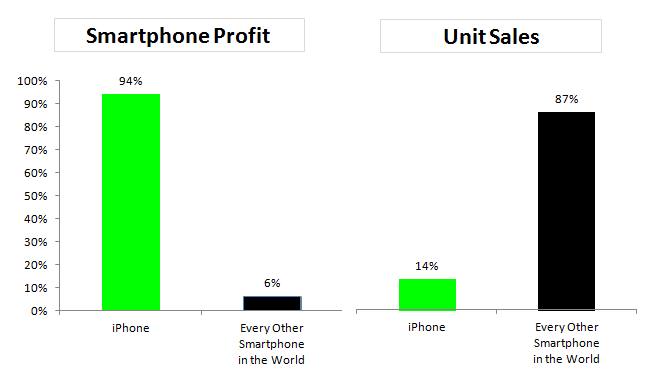
Over the years, I have stressed to students and executives that market share does not equal profitability in many cases.   Often firms set market share targets, and they become obsessed with being number one in share.  They forget that share is not always highly correlated with profitability.  My colleague, Lou Mazzucchelli, shared with me this incredible chart about smartphone sales that makes this point in a memorable and impactful way.  

Source:  Canaccord Research

Thursday, November 19, 2015

Great Commercial: Using Cliches to Your Advantage


Fast Company's Jeff Beer has a short piece about a new commercial from Bobble, maker of reusable water bottles.  The advertisement features a fake brand (Once), and it ridicules those who drink bottled water from disposable plastic bottles.  Beer writes,

If you watch enough advertising aimed at anyone aged 14 to 30, certain patterns of tone, image, and style emerge. Young people, just livin' the good life, embracing the moment, seizing the day and all that. To draw attention to the huge amount of waste created by single-use plastic water bottles, reusable bottle brand Bobble has tapped all these well-tread commercial cliches to reach the exact same audience.

The advertisement is fascinating precisely because it highlights another side to these cliches about how millennials should live their lives.   Moreover, as the advertising agency managing director, James Townsend noted, "It's more effective to make something look uncool than it is to say it's bad for you."  

Wednesday, November 18, 2015

Starbucks vs. Dunkin - The Challenge of Strategy Convergence

Bloomberg reports today that Dunkin' Donuts has launched a mobile ordering and delivery initiative.  In Maine, they are testing a service that enables customers to order drinks and food through a smartphone app.  Meanwhile, in Texas, they are testing a delivery service.  Dunkin's move follows the launch of mobile ordering several months ago by rival Starbucks.  

The competitive dynamic between these two coffee chains reminds us of the perils of strategy convergence.  Think about these two chains twenty years ago.  They were quite different.  Each had a very unique competitive position.  Today, their positions are more similar (though clearly not alike).   Twenty years ago, Starbucks did not offer drive-thru service, while Dunkin' did.   Starbucks offered wi-fi many years ago, while Dunkin' added that service later.  Starbucks has offered lattes from the start, while Dunkin' added that product more recently.  Dunkin' has had a lucrative food business to go along with its coffee from the start, while Starbucks has struggled with its food lineup and made changes numerous times to improve it.  For many years, Starbucks has sold its packaged coffee in supermarkets for customers to brew at home.  Dunkin' started doing that as well in recent years.  

What's my point?  Well, the strategies of these two firms have converged in recent years.  Yes, they are still quite distinct, but not as different as they once were.  As markets become more mature, strategy convergence tends to occur.  However, the worry is when strategies converge to the point where company positions begin to blur.   The challenge is to remain distinctive even as markets mature.  Gary Hamel put it best when he wrote, 

In nearly every industry, strategies tend to cluster around some central tendency of industry orthodoxy.  Strategies converge because success recipes get lavishly imitated…Aiding and abetting strategy convergence is an ever-growing army of eager young consultants transferring best practice from leaders to laggards…  The challenge of maintaining any sort of competitive differentiation goes up proportionately with the number of consultants moving management wisdom around the world.

Tuesday, November 17, 2015

Internal Promotions vs. Switching Companies

Wharton Professors Matthew Bidwell and Ethan Mollick have conducted research on external vs. internal mobility of employees during their careers.   Here's what they have found (excerpt from interview with Professor Bidwell by Knowledge@Wharton):  

We found quite big differences between the moves that took place inside the firms, and the moves that took place across the firms. When people are moving inside firms, we saw that they got a pay raise. They also got quite a big increase in responsibility — they tended to rise up, in terms of their title. And they pretty much doubled the number of people that they were managing.

When people moved jobs across firms, they also got a pay raise, but it didn’t tend to come with an increase in responsibilities. Instead, they were moving to a job with often a similar title, and usually with the same number of subordinates — managing the same number of people. And so they weren’t necessarily getting a promotion in the same way.

This speaks to the different reasons for moving. When people are moving inside [the firm], they’re moving up the ladder. When people are moving to jobs in other firms, they’re getting a pay raise. They get paid to move. But they’re not making the same kind of move up the ladder. They’re moving to a similar rung, albeit in a different organization.

The authors offer several cautionary notes for firms and employees alike.  For companies, beware that you are often going to have to pay a premium when relying on external talent to fill key positions.   You pay that premium even though you often are not providing that person with additional responsibilities relative to what they had at their previous firm.   For employees, beware that hopping from one firm to another may get you an immediate pay raise, but it may delay future promotions and pay increases, costing you money down the road.   The authors do not suggest that one should stay at the same firm forever.  However, they do caution against taking a job at a firm where career advancement seems unlikely.   Being able to land a few promotions before moving to another company can be the better long term strategy for career advancement, development, and compensation. 

Monday, November 16, 2015

Netflix, Analytics, and Original Programming

Many former and current students have asked me about Netflix's decision to offer original programming.  They always want to know, "Does vertical integration make sense for Netflix or not?"  They know that vertical integration has not always worked out in entertainment industry (think the breakup of Viacom/CBS and the unfortunate consequences of the AOL-Time Warner merger).  I ran across this CNBC interview with Netflix CEO Reed Hastings today (thank you, Professor Jay Rao, for pointing me in this direction!).   Hastings commented on the company's original programming:

Hastings attributed the success of original programming such as "Orange is the New Black" and "House of Cards" to Netflix's powerful data analytics.  "We are just a learning machine. Every time we put out a new show, we are analyzing it, figuring out what worked and what didn't so we get better next time," Hastings added.

Hastings' comments suggest that vertical integration may make a great deal of sense in this case, because Netflix can increase the odds of success with its original programming due to data analytics.  How powerful can data be in this case?  Well, if think about it, Netflix has been invested in "big data" since its inception in the late 1990s (long before big data became a common term).   From the beginning, Netflix did not want to focus on new releases. It wanted to be able to offer a deep library, and then use data to recommend lesser known titles to people.  Now, it's taking that data analytics to a whole new level, by using information it has compiled for over fifteen years to develop original programming.  As we all know, the failure rate for new shows can be quite high.   If Netflix can reduce that rate, even just by a small margin, it can improve the economics of programming substantially.  

Saturday, November 14, 2015

Does Expertise Make Us Close-Minded?

The British Psychological Society reports on a new study by Ottati, Price, Wilson, and Sumaktoyo.  The article, "When self-perceptions of expertise increase closed-minded cognition: The earned dogmatism effect," was published in the Journal of Experimental Social Psychology.   The research consisted of a series of six experiments.  In the research, people were made to feel like they were either experts or novices in a particular knowledge domain.   The scholars found that those who felt as though they were experts tended to act in a more close-minded fashion in subsequent parts of the study.  Hmmm... perhaps all of us at universities should look in the mirror.  Does the level of perceived expertise in academia contribute to a close-mindedness that inhibits the type of learning, exploration, and open dialogue that should be occurring in our classrooms?  Similarly, in a business context, does expertise close managers and technical experts off to new possibilities and make them more vulnerable to disruptive innovation? 

Thursday, November 12, 2015

Big Data in Formula 1 Racing: Don't Overwhelm Humans

Fortune has a fascinating article about how Formula 1 teams are using the internet of things and data analytics to win auto races.   According to the article, 

"These machines, each valued at more than $9 million (a steering wheel alone is worth $77,000 or so) are more than just pricey contraptions capable of whizzing around the track at more than 200 miles per hour. They are also intelligent, thanks to the many dozens of sensors fastened to them. Each sensor communicates with the track, the crew in the pit, a broadcast crew on-site, and a second team of engineers back home in Europe."  

The team then uses predictive algorithms to help them understand how the car will perform under certain track conditions.  These data guide key decisions.  However, they are careful not to put too much on the driver's plate.  After all, he or she is concentrating on many factors while driving at a very high rate of speed.   The team doesn't want to overwhelm the "cognitive capacity" of the driver.  In other words, they have to boil all that data down to a few key items about which they want to make the driver aware.  

That description sounds quite similar to how a great football coach operates.  They conduct extensive analysis of the opponent, breaking down game film and evaluating data about the strengths and weaknesses of that team.  The coaches then build game plan.  However, they have to keep the ultimate plan simple enough so that players can make fast decisions on the field.  They want them to still act instinctively and not be overwhelmed by too much information.   Managers in all types of enterprises should take note.   We want data analysis to guide people's decisions, but we have to keep in mind the cognitive capacity of those individuals.  We have to be able to boil down all that data to a few key principles and recommendations that they can implement effectively and quickly. 

Tuesday, November 10, 2015

Finding Inspiration: Get on the Move


Deepen Your Value Proposition Before Diversifying

Elizabeth Segran has a very good article at Fast Company this week titled, "How to Build a Business That Matters."   She interviews several very successful entrepreneurs.  One piece of advice really stuck out for me.   She writes, "The value proposition has to be deep."   She cites the example of Birchbox, a company founded by Katia Beauchamp and Hayley Barna.  The two women founded a company that offers a subscription service that delivers a set of samples of beauty products to its customers each month.   The startup soon realized that its service was a major hit.  That's a great story, right?  They came up with an innovative idea that clearly met customer needs (people want to try beauty products before they make major purchases).  

What's the problem?  Well, many competitors arose, and others launched similar services in other markets.  How could Birchbox build and defend its competitive advantage?  Beauchamp said, "We understood that the value proposition had to be deep for us to become a staple in consumers’ lives.  It couldn’t just be fun, because fun wears off. It couldn’t just be pretty, because eventually you have enough pretty things."   Thus, the company developed its analytics capabilities so that customers could receive a very personalized set of product samples.   Those analytics capabilities also could provide critical information to beauty product manufacturers, so that they could create new products that customer needs.  Then they worked to get exciting new products to their customers before the competition, and to make it as easy as possible for customers to purchase products from their online store, if they liked the samples.  

In sum, they didn't just rest on their laurels when the initial idea proved a hit.  They deepened the relationship with customers in ways that were much harder to imitate than the initial business concept.  That's what all entrepreneurs must do.  Unfortunately, many entrepreneurs start diversifying into new products and services in search of additional growth before they have fully established a sustainable position in their initial market.  They don't work hard enough at times to make their initial concept hard to imitate.  They don't deepen their relationship with existing customers enough before moving on to new customers and product markets. 

Friday, November 06, 2015

The Decline of Creativity in Innovative Organizations

James March, Mie Augier, and Andrew Marshall published a paper on innovation recently in Organization Science.  The article was titled,  “The Flaring of Intellectual Outliers: An Organizational Interpretation of the Generation of Novelty in the RAND Corporation.”   In the paper, the scholars try to explain the rise and fall of a culture of innovation at RAND.   Stanford's Louise Lee summarized their findings: 

RAND’s growth as an organization also led to a decline in its culture of innovation. From 1948 to 1962, RAND grew from 225 employees with a $3.5 million annual budget to 1,100 employees with a more than $20 million annual budget, according to the researchers. Growth has benefits, but RAND’s expansion beyond a face-to-face organization led individuals to stick safely with the people and thus the ideas they knew, instead of mingling freely. Big organizations also tend to hire people who conform to conventional methods and thinking instead of challenging them; meanwhile, the ambitious intellectual renegades leave, the researchers say. RAND’s growth also created layers of administrators and more bureaucratic processes such as meetings, committees, and other “red tape” that drowned out intellectual creativity, the researchers found.

Does that description apply to your organization?  Are people playing it safe much more so today than in the past?  Are they hiring people who conform rather than challenge?  Are people not mingling enough with folks outside their technical domain or discipline? 

Wednesday, November 04, 2015

Creativity, Entitlement, & Unethical Behavior

Maryam Kouchaki of the Kellogg School and Lynne Vincent of Syracuse University’s Whitman School of Management have conducted some fascinating experimental research addressing the relationship among creativity, entitlement, and unethical behavior.   They conducted an interesting experiment in which they gave subjects a test to examine their creative potential.  Some were told that they scored highly, and that many others did as well.  Others were told that they stood out, scoring much higher than the typical participant.  Then the subjects participated in a game in which dishonest behavior could yield higher payoffs.  Here's what they found, according to Kellogg Insights:

The results show that when participants were told they were creative but that creativity is common, there was no adverse effect on behavior. It was when they were told that they were uniquely creative that bad behavior ensued. Participants who had been told that they were creative and that creativity is rare were more than twice as likely to lie to their partners in the game than those in the other two groups. That same group also had a much higher entitlement score on a post-game questionnaire, which asked participants to rate their level of agreement with statements like, “I honestly feel I’m just more deserving than others.”

Kouchaki offers the key takeaway from this line of research:  She notes, “You want to encourage a culture of creativity, rather than a special treatment of creative people.”  I would add one other important notion to her conclusion.  It's not constructive to categorize employees (the creative, innovative folks vs. the "regular" people). That's a recipe for decreasing engagement and fostering resentment.  Moreover, it's not the way to drive innovation.  You don't want to bet on a flash of lightning from a select few.  Instead, you want to leverage the collective intellect of the crowd.  You absolutely want to create a culture where everyone feels responsible for coming up with better ways of working, improved products, enhanced systems and processes, etc. 

Tuesday, November 03, 2015

Why Do the Bad Guys and Gals Win at Work?

Do the bad guys and gals actually win, and the nice folks finish last, in organizations?   Tomas Chamorro-Premuzic, CEO of Hogan Assessment Systems and Professor of Business Psychology at University College London, writes about this interesting question in an HBR blog post today.   He examines the "dark triad" of personality traits:  psychopathy, narcissism, and Machiavellianism. 

Chamorro-Premuzic reviews the literature about these three traits.   He writes:

It should be noted that, unlike clinical personality traits, these traits are normally distributed in the population – e.g., you can score low, average or high – and perfectly indicative of normal functioning. In other words, just because you score high doesn’t mean that you have problems, either at work or in your personal life. And despite the antisocial implications of the dark triad, recent research has highlighted a wide range of career-related benefits for these personality characteristics... An impressive 15-year longitudinal study found that individuals with psychopathic and narcissistic characteristics gravitated towards the top of the organizational hierarchy and had higher levels of financial attainment. In line with those findings, according to some estimates, the base rate for clinical levels of psychopathy is three times higher among corporate boards than in the overall population.

Why do the bad guys and gals rise to the top of many organizations?  He points out that these folks tend to have higher self-esteem.  Moreover, they tend to be extroverted and charming.  They are curious and competitive.   They can seduce and intimidate.   Self-esteem, charm, curiosity... these are not bad things.  In short, there's a "bright side to the dark side."  The problem is when you are extreme with regard to this "dark triad" of psychopathy, narcissism, and Machiavellianism.  In that case, the bad guy or gal may succeed in getting to the top, but at the expense of organizational effectiveness.