Friday, November 20, 2015

Market Share Does Not Equal Profitability

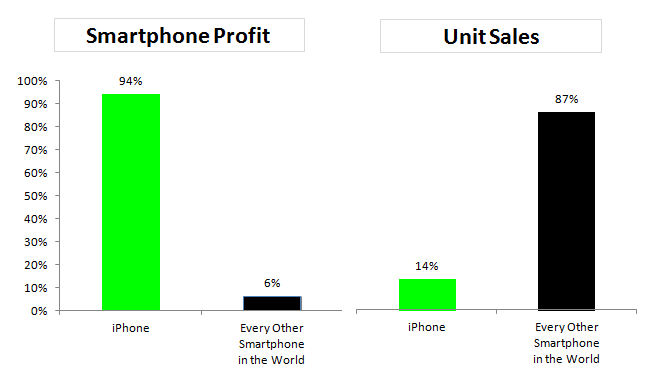
Over the years, I have stressed to students and executives that market share does not equal profitability in many cases.   Often firms set market share targets, and they become obsessed with being number one in share.  They forget that share is not always highly correlated with profitability.  My colleague, Lou Mazzucchelli, shared with me this incredible chart about smartphone sales that makes this point in a memorable and impactful way.  

Source:  Canaccord Research

Thursday, November 19, 2015

Great Commercial: Using Cliches to Your Advantage


Fast Company's Jeff Beer has a short piece about a new commercial from Bobble, maker of reusable water bottles.  The advertisement features a fake brand (Once), and it ridicules those who drink bottled water from disposable plastic bottles.  Beer writes,

If you watch enough advertising aimed at anyone aged 14 to 30, certain patterns of tone, image, and style emerge. Young people, just livin' the good life, embracing the moment, seizing the day and all that. To draw attention to the huge amount of waste created by single-use plastic water bottles, reusable bottle brand Bobble has tapped all these well-tread commercial cliches to reach the exact same audience.

The advertisement is fascinating precisely because it highlights another side to these cliches about how millennials should live their lives.   Moreover, as the advertising agency managing director, James Townsend noted, "It's more effective to make something look uncool than it is to say it's bad for you."  

Wednesday, November 18, 2015

Starbucks vs. Dunkin - The Challenge of Strategy Convergence

Bloomberg reports today that Dunkin' Donuts has launched a mobile ordering and delivery initiative.  In Maine, they are testing a service that enables customers to order drinks and food through a smartphone app.  Meanwhile, in Texas, they are testing a delivery service.  Dunkin's move follows the launch of mobile ordering several months ago by rival Starbucks.  

The competitive dynamic between these two coffee chains reminds us of the perils of strategy convergence.  Think about these two chains twenty years ago.  They were quite different.  Each had a very unique competitive position.  Today, their positions are more similar (though clearly not alike).   Twenty years ago, Starbucks did not offer drive-thru service, while Dunkin' did.   Starbucks offered wi-fi many years ago, while Dunkin' added that service later.  Starbucks has offered lattes from the start, while Dunkin' added that product more recently.  Dunkin' has had a lucrative food business to go along with its coffee from the start, while Starbucks has struggled with its food lineup and made changes numerous times to improve it.  For many years, Starbucks has sold its packaged coffee in supermarkets for customers to brew at home.  Dunkin' started doing that as well in recent years.  

What's my point?  Well, the strategies of these two firms have converged in recent years.  Yes, they are still quite distinct, but not as different as they once were.  As markets become more mature, strategy convergence tends to occur.  However, the worry is when strategies converge to the point where company positions begin to blur.   The challenge is to remain distinctive even as markets mature.  Gary Hamel put it best when he wrote, 

In nearly every industry, strategies tend to cluster around some central tendency of industry orthodoxy.  Strategies converge because success recipes get lavishly imitated…Aiding and abetting strategy convergence is an ever-growing army of eager young consultants transferring best practice from leaders to laggards…  The challenge of maintaining any sort of competitive differentiation goes up proportionately with the number of consultants moving management wisdom around the world.

Tuesday, November 17, 2015

Internal Promotions vs. Switching Companies

Wharton Professors Matthew Bidwell and Ethan Mollick have conducted research on external vs. internal mobility of employees during their careers.   Here's what they have found (excerpt from interview with Professor Bidwell by Knowledge@Wharton):  

We found quite big differences between the moves that took place inside the firms, and the moves that took place across the firms. When people are moving inside firms, we saw that they got a pay raise. They also got quite a big increase in responsibility — they tended to rise up, in terms of their title. And they pretty much doubled the number of people that they were managing.

When people moved jobs across firms, they also got a pay raise, but it didn’t tend to come with an increase in responsibilities. Instead, they were moving to a job with often a similar title, and usually with the same number of subordinates — managing the same number of people. And so they weren’t necessarily getting a promotion in the same way.

This speaks to the different reasons for moving. When people are moving inside [the firm], they’re moving up the ladder. When people are moving to jobs in other firms, they’re getting a pay raise. They get paid to move. But they’re not making the same kind of move up the ladder. They’re moving to a similar rung, albeit in a different organization.

The authors offer several cautionary notes for firms and employees alike.  For companies, beware that you are often going to have to pay a premium when relying on external talent to fill key positions.   You pay that premium even though you often are not providing that person with additional responsibilities relative to what they had at their previous firm.   For employees, beware that hopping from one firm to another may get you an immediate pay raise, but it may delay future promotions and pay increases, costing you money down the road.   The authors do not suggest that one should stay at the same firm forever.  However, they do caution against taking a job at a firm where career advancement seems unlikely.   Being able to land a few promotions before moving to another company can be the better long term strategy for career advancement, development, and compensation. 

Monday, November 16, 2015

Netflix, Analytics, and Original Programming

Many former and current students have asked me about Netflix's decision to offer original programming.  They always want to know, "Does vertical integration make sense for Netflix or not?"  They know that vertical integration has not always worked out in entertainment industry (think the breakup of Viacom/CBS and the unfortunate consequences of the AOL-Time Warner merger).  I ran across this CNBC interview with Netflix CEO Reed Hastings today (thank you, Professor Jay Rao, for pointing me in this direction!).   Hastings commented on the company's original programming:

Hastings attributed the success of original programming such as "Orange is the New Black" and "House of Cards" to Netflix's powerful data analytics.  "We are just a learning machine. Every time we put out a new show, we are analyzing it, figuring out what worked and what didn't so we get better next time," Hastings added.

Hastings' comments suggest that vertical integration may make a great deal of sense in this case, because Netflix can increase the odds of success with its original programming due to data analytics.  How powerful can data be in this case?  Well, if think about it, Netflix has been invested in "big data" since its inception in the late 1990s (long before big data became a common term).   From the beginning, Netflix did not want to focus on new releases. It wanted to be able to offer a deep library, and then use data to recommend lesser known titles to people.  Now, it's taking that data analytics to a whole new level, by using information it has compiled for over fifteen years to develop original programming.  As we all know, the failure rate for new shows can be quite high.   If Netflix can reduce that rate, even just by a small margin, it can improve the economics of programming substantially.  

Saturday, November 14, 2015

Does Expertise Make Us Close-Minded?

The British Psychological Society reports on a new study by Ottati, Price, Wilson, and Sumaktoyo.  The article, "When self-perceptions of expertise increase closed-minded cognition: The earned dogmatism effect," was published in the Journal of Experimental Social Psychology.   The research consisted of a series of six experiments.  In the research, people were made to feel like they were either experts or novices in a particular knowledge domain.   The scholars found that those who felt as though they were experts tended to act in a more close-minded fashion in subsequent parts of the study.  Hmmm... perhaps all of us at universities should look in the mirror.  Does the level of perceived expertise in academia contribute to a close-mindedness that inhibits the type of learning, exploration, and open dialogue that should be occurring in our classrooms?  Similarly, in a business context, does expertise close managers and technical experts off to new possibilities and make them more vulnerable to disruptive innovation? 

Thursday, November 12, 2015

Big Data in Formula 1 Racing: Don't Overwhelm Humans

Fortune has a fascinating article about how Formula 1 teams are using the internet of things and data analytics to win auto races.   According to the article, 

"These machines, each valued at more than $9 million (a steering wheel alone is worth $77,000 or so) are more than just pricey contraptions capable of whizzing around the track at more than 200 miles per hour. They are also intelligent, thanks to the many dozens of sensors fastened to them. Each sensor communicates with the track, the crew in the pit, a broadcast crew on-site, and a second team of engineers back home in Europe."  

The team then uses predictive algorithms to help them understand how the car will perform under certain track conditions.  These data guide key decisions.  However, they are careful not to put too much on the driver's plate.  After all, he or she is concentrating on many factors while driving at a very high rate of speed.   The team doesn't want to overwhelm the "cognitive capacity" of the driver.  In other words, they have to boil all that data down to a few key items about which they want to make the driver aware.  

That description sounds quite similar to how a great football coach operates.  They conduct extensive analysis of the opponent, breaking down game film and evaluating data about the strengths and weaknesses of that team.  The coaches then build game plan.  However, they have to keep the ultimate plan simple enough so that players can make fast decisions on the field.  They want them to still act instinctively and not be overwhelmed by too much information.   Managers in all types of enterprises should take note.   We want data analysis to guide people's decisions, but we have to keep in mind the cognitive capacity of those individuals.  We have to be able to boil down all that data to a few key principles and recommendations that they can implement effectively and quickly. 

Tuesday, November 10, 2015

Finding Inspiration: Get on the Move


Deepen Your Value Proposition Before Diversifying

Elizabeth Segran has a very good article at Fast Company this week titled, "How to Build a Business That Matters."   She interviews several very successful entrepreneurs.  One piece of advice really stuck out for me.   She writes, "The value proposition has to be deep."   She cites the example of Birchbox, a company founded by Katia Beauchamp and Hayley Barna.  The two women founded a company that offers a subscription service that delivers a set of samples of beauty products to its customers each month.   The startup soon realized that its service was a major hit.  That's a great story, right?  They came up with an innovative idea that clearly met customer needs (people want to try beauty products before they make major purchases).  

What's the problem?  Well, many competitors arose, and others launched similar services in other markets.  How could Birchbox build and defend its competitive advantage?  Beauchamp said, "We understood that the value proposition had to be deep for us to become a staple in consumers’ lives.  It couldn’t just be fun, because fun wears off. It couldn’t just be pretty, because eventually you have enough pretty things."   Thus, the company developed its analytics capabilities so that customers could receive a very personalized set of product samples.   Those analytics capabilities also could provide critical information to beauty product manufacturers, so that they could create new products that customer needs.  Then they worked to get exciting new products to their customers before the competition, and to make it as easy as possible for customers to purchase products from their online store, if they liked the samples.  

In sum, they didn't just rest on their laurels when the initial idea proved a hit.  They deepened the relationship with customers in ways that were much harder to imitate than the initial business concept.  That's what all entrepreneurs must do.  Unfortunately, many entrepreneurs start diversifying into new products and services in search of additional growth before they have fully established a sustainable position in their initial market.  They don't work hard enough at times to make their initial concept hard to imitate.  They don't deepen their relationship with existing customers enough before moving on to new customers and product markets. 

Friday, November 06, 2015

The Decline of Creativity in Innovative Organizations

James March, Mie Augier, and Andrew Marshall published a paper on innovation recently in Organization Science.  The article was titled,  “The Flaring of Intellectual Outliers: An Organizational Interpretation of the Generation of Novelty in the RAND Corporation.”   In the paper, the scholars try to explain the rise and fall of a culture of innovation at RAND.   Stanford's Louise Lee summarized their findings: 

RAND’s growth as an organization also led to a decline in its culture of innovation. From 1948 to 1962, RAND grew from 225 employees with a $3.5 million annual budget to 1,100 employees with a more than $20 million annual budget, according to the researchers. Growth has benefits, but RAND’s expansion beyond a face-to-face organization led individuals to stick safely with the people and thus the ideas they knew, instead of mingling freely. Big organizations also tend to hire people who conform to conventional methods and thinking instead of challenging them; meanwhile, the ambitious intellectual renegades leave, the researchers say. RAND’s growth also created layers of administrators and more bureaucratic processes such as meetings, committees, and other “red tape” that drowned out intellectual creativity, the researchers found.

Does that description apply to your organization?  Are people playing it safe much more so today than in the past?  Are they hiring people who conform rather than challenge?  Are people not mingling enough with folks outside their technical domain or discipline? 

Wednesday, November 04, 2015

Creativity, Entitlement, & Unethical Behavior

Maryam Kouchaki of the Kellogg School and Lynne Vincent of Syracuse University’s Whitman School of Management have conducted some fascinating experimental research addressing the relationship among creativity, entitlement, and unethical behavior.   They conducted an interesting experiment in which they gave subjects a test to examine their creative potential.  Some were told that they scored highly, and that many others did as well.  Others were told that they stood out, scoring much higher than the typical participant.  Then the subjects participated in a game in which dishonest behavior could yield higher payoffs.  Here's what they found, according to Kellogg Insights:

The results show that when participants were told they were creative but that creativity is common, there was no adverse effect on behavior. It was when they were told that they were uniquely creative that bad behavior ensued. Participants who had been told that they were creative and that creativity is rare were more than twice as likely to lie to their partners in the game than those in the other two groups. That same group also had a much higher entitlement score on a post-game questionnaire, which asked participants to rate their level of agreement with statements like, “I honestly feel I’m just more deserving than others.”

Kouchaki offers the key takeaway from this line of research:  She notes, “You want to encourage a culture of creativity, rather than a special treatment of creative people.”  I would add one other important notion to her conclusion.  It's not constructive to categorize employees (the creative, innovative folks vs. the "regular" people). That's a recipe for decreasing engagement and fostering resentment.  Moreover, it's not the way to drive innovation.  You don't want to bet on a flash of lightning from a select few.  Instead, you want to leverage the collective intellect of the crowd.  You absolutely want to create a culture where everyone feels responsible for coming up with better ways of working, improved products, enhanced systems and processes, etc. 

Tuesday, November 03, 2015

Why Do the Bad Guys and Gals Win at Work?

Do the bad guys and gals actually win, and the nice folks finish last, in organizations?   Tomas Chamorro-Premuzic, CEO of Hogan Assessment Systems and Professor of Business Psychology at University College London, writes about this interesting question in an HBR blog post today.   He examines the "dark triad" of personality traits:  psychopathy, narcissism, and Machiavellianism. 

Chamorro-Premuzic reviews the literature about these three traits.   He writes:

It should be noted that, unlike clinical personality traits, these traits are normally distributed in the population – e.g., you can score low, average or high – and perfectly indicative of normal functioning. In other words, just because you score high doesn’t mean that you have problems, either at work or in your personal life. And despite the antisocial implications of the dark triad, recent research has highlighted a wide range of career-related benefits for these personality characteristics... An impressive 15-year longitudinal study found that individuals with psychopathic and narcissistic characteristics gravitated towards the top of the organizational hierarchy and had higher levels of financial attainment. In line with those findings, according to some estimates, the base rate for clinical levels of psychopathy is three times higher among corporate boards than in the overall population.

Why do the bad guys and gals rise to the top of many organizations?  He points out that these folks tend to have higher self-esteem.  Moreover, they tend to be extroverted and charming.  They are curious and competitive.   They can seduce and intimidate.   Self-esteem, charm, curiosity... these are not bad things.  In short, there's a "bright side to the dark side."  The problem is when you are extreme with regard to this "dark triad" of psychopathy, narcissism, and Machiavellianism.  In that case, the bad guy or gal may succeed in getting to the top, but at the expense of organizational effectiveness.  

Thursday, October 29, 2015

Individual vs. Group Decision Making in the Venture Capital World

Wharton doctoral candidate Andy Wu has conducted some interesting research about decision making in the venture capital world.    He explains his research to Knowledge@Wharton:

My current work focuses on the role of partners of venture capital firms who make angel investments on the side. What that allows us to do is compare organizational decision-making to individual decision-making. In this work, we find that individuals acting alone are able to process private information that they have that their organization doesn’t have, and allows them to make investments in firms with observably weaker characteristics, such as younger founding teams, less educated founding teams. Nevertheless, these individual investors are able to generate the same financial return as their employing firms.

What does Wu mean by private information?  Well, he's really referring to tacit knowledge... expertise that cannot be easily transmitted to others.  Your intuition may tell you that a certain investment is attractive or not.   The data do not justify your conclusions.  How do you persuade your partners in the firm?  Wu argues that you often do not persuade them.   You can't make a strong, rational, explicit case to them.  However, tacit knowledge leads you to conclude that it's a good investment.  Groups, Wu argues, focus on explicit information and often fail to incorporate crucial tacit knowledge.  

Wednesday, October 28, 2015

REI Shuts Stores on Black Friday! What Are They Doing?!

REI made a rather stunning announcement today.  The firm will be closing all of its stores on Black Friday, the biggest shopping day of the year.  Instead, it will pay its employees to explore and enjoy the outdoors on that day, and it will encourage its customers to do the same.  The company has launched a social media campaign in conjunction with their unique Black Friday strategy.  They have adopted the hashtag "OptOutside" and encouraged people to share their ideas and experiences for enjoying the outdoors on Black Friday.   Jerry Stritzke, president and CEO of REI, explained the company's reasoning: “Black Friday is the perfect time to remind ourselves of the essential truth that life is richer, more connected and complete when you choose to spend it outside. We’re closing our doors, paying our employees to get out there, and inviting America to OptOutside with us because we love great gear, but we are even more passionate about the experiences it unlocks.”  

I love the idea!  I've always felt that the Black Friday phenomenon had become a sort of Prisoner's Dilemma for firms.   Each company opened earlier to keep up with or one up the competition.  Some firms even began opening on Thanksgiving itself.  Promotions became even crazier with each passing year.  Yet, such moves often only shifted sales from other days.  They did not add to total holiday spending necessarily.  Thus, firms incurred more costs without actually improving revenues overall.  No firm wanted to opt out of this arms race though, for fear of the damage they would suffer if they didn't keep up with the competition.  Now, we have seen one firm choose to opt out of the arms race.  Great firms zig whenever everyone else zags.  They find a way to differentiate.  For REI, the move fits beautifully with their brand image and their values.  It reinforces all that we believe about REI's brand, culture, and beliefs.  It helps them stand out from the competition.   The key question: Will other firms follow?  I doubt it that many will follow.  Actually, simply copying REI's strategy does not make much sense anyway.   Being different is the key to building a great strategy.   Other firms may want to adapt their Black Friday strategy to avoid the arms race that I describe above, but they will have to find their own unique way of doing so.  

The NFL: Could Growth Obsession Become its Downfall?

The National Football League has never been more popular in the United States.  The league enjoys record ratings and lucrative television contracts.  Long ago, the league surpassed major league baseball as the national pastime.  However, many observers have noted a substantial decline in the quality of play recently.  Are such observations just the usual nostalgic "it ain't like the glory days" comments, or is there some truth to the comments?   That's hard to tell at the moment, though the league does appear to have an inequality not seen in some time (record number of 6-0 teams at this point in the season comes with an incredible amount of futility as well).  

What could be driving a decline in the quality of play?  I would hypothesize that the obsession with revenue growth has diluted quality... something we see in many industries.  The NFL is not immune to that phenomenon.   How has revenue growth obsession damaged quality?   One reason may be that the desire for growth has led to a huge shift in emphasis toward offense.   Fantasy sports have contributed greatly to that emphasis on offense.   As the emphasis has shifted toward increasing scoring, the league has become very pass happy.  The running game has diminished in importance.  How does that lead to decreased quality?  Well, for one thing, the incredible emphasis on passing offense means that one player, the quarterback, is more important than ever.   The quarterback has always been the most important position on the field, but now the critical need for superb play at that one position is elevated substantially.   In the past, you could win in multiple ways.   You could run the ball in a dominant fashion.  You could have a monster defense.  Today, the old adage "run the ball and stop the run" just does not apply.   If you do not have a superb quarterback, you are going to struggle to win consistently.   Recall that quarterbacks such as Mark Rypien, Brad Johnson, Trent Dilfer won Super Bowls in the past.  That seems increasingly difficult in this new era.  The problem, then, is that the league does not have enough quarterbacks who can play at a very high level.  This year, Peyton Manning has suffered a decline in skills due to age and injury, and other top QBs (Luck, Roethlisberger, Brees) have been injured or have played poorly.  So, in a rush to drive revenue growth, the league made itself more dependent on one position, the quarterback.  However, it does not have enough excellent quarterbacks to maintain a high level of play.  

That's my hypothesis.  The NFL is not immune to the basic tradeoff that many firms face... top line obsession can lead to brand and quality dilution.  The ratings continue to soar, but will this problem eventually lead to a loss of viewers?    I don't know... I still watch, but then again, I have the privilege of watching the greatest quarterback of all time each week.

Tuesday, October 27, 2015

Do Firms Really Value Curiosity?

George Mason University Professor Todd  Kashdan has conducted a study about curiosity in the workplace.  He found that companies talk a good talk about curiosity and new ideas, but they don't walk the walk.   Kashdan reports, "Surveying workers in 16 industries, we found that while 65% said that curiosity was essential to discover new ideas, virtually the same percentage felt unable to ask questions on the job. The contradictions continued: while 84% reported that their employers encouraged curiosity, 60% said they had also encountered barriers to it at work."  

What types of barriers do workers cite?  According to Kashdan, "Common stumbling blocks cited (across industries) were a top-down approach to decision-making, limited time for creative thinking, a preference for safe ideas over new ones, and fear of standing out from the pack. How can these and other organizations do better?"  

We have seen the many reports about low employee engagement across a variety of industries and firms.  Why is engagement so low in the American workforce?  One reason may be that employees have become disenchanted by too many instances of leaders talking a good game, but not acting in ways that are consistent with those verbal messages.  Not backing up your words with actions can be a very easy way to lose the trust of your employees.  The research here on curiosity offers one example of a situation in which firms and their leaders appear to be dropping the ball. 


Thursday, October 22, 2015

Lessons from the Cuban Missile Crisis

Source:  Boston Globe (from JFK Library)
On this day in 1962, President John F. Kennedy addressed the nation to discuss the Cuban Missile Crisis.  In his speech, Kennedy informed the public that the U.S. would be establishing a naval quarantine around the island of Cuba until the missiles were removed.  I have written extensively about Kennedy's decision-making process during the crisis.   Ten years ago, I had the opportunity to talk to Kennedy's Secretary of Defense, Robert McNamara, about the crisis.  He came to Harvard to address my students at that time.  For more on what we can learn from how Kennedy led his team through that ordeal, you might wish to read an article that I published in the Ivey Business Journal.  

Wednesday, October 21, 2015

When You Are Overly Dependent on One Product: Apple's "Problem"

The Wall Street Journal has a great chart today (shown here) that highlights how increasingly dependent Apple has become on the iPhone as the one product driving a substantial portion of revenue and profit.   Many analysts have expressed concern about this dependency.  I find it an interesting discussion.  On the one hand, it does appear worrisome to have so much of the company's fate reliant on one particular blockbuster product. On the other hand, a firm has to be careful how it responds to this type of "problem" that emerges with success.  Diversifying recklessly simply to reduce dependency on a single product can be a recipe for disaster...yet many firms have made that mistake when faced with this situation.  Moreover, we know that focus can be a powerful dimension of any strategy.  Jobs preached focus relentlessly during his time at Apple (and at Pixar).   Will a company lose focus if it tries "too hard" to reduce reliance on one hit product?  It's a delicate balancing act, and it will be interesting to see how Apple navigates this situation in the years to come. 


Tuesday, October 20, 2015

Amazon Hits Back at The New York Times: Why Now?

Yesterday, Amazon's Jay Carney (former White House Press Secretary) published a post on Medium that criticized the New York Times scathing article published two months ago about Amazon's culture and workplace environment.    The newspaper offered a quick rebuttal.   My question: Why now?  Why offer this rebuttal two months after the article ran?  The controversy had died down, after receiving a great deal of attention two months ago.  Why bring the issues back to the forefront now?  It only serves to remind people about the negative statements and observations made about Amazon's organization.  Moreover, as The New York Times stated, the Carney post did not refute the claims made in the article directly, but instead only pointed out that some of the quotes came from highly disgruntled employees (at least one of whom may have been fired for wrongdoing).   In a situation such as this one, offering a clear rebuttal may be good policy, but timing is important.  You have to move quickly.  In many ways, you only rekindle the controversy by responding now.

Monday, October 19, 2015

Confirmation Bias

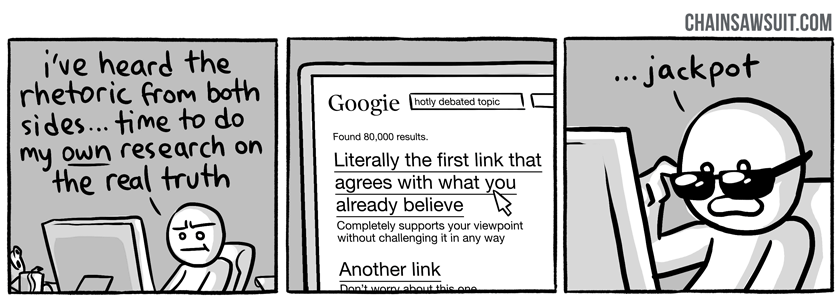
I discovered this terrific comic about confirmation bias today.  
https://pbs.twimg.com/media/ByFacoMIcAA2roX.png:large

Normalization of Deviance at Volkswagen?

Paul Kedrosky, a venture investor, wrote a very interesting column for The New Yorker about the Volkswagen scandal.  He does not introduce new facts, but instead speculates as to how the ethical and legal transgressions may have taken place.  He draws upon Diane Vaughan's great work on the Challenger space shuttle accident.  In her research, Vaughan describes a phenomenon that she calls the "normalization of deviance."  It's a process whereby we gradually engage in riskier behavior.  We don't jump over the line from legal/ethical to illegal/unethical.  Instead, we inch our way there over time.  As Vaughan puts it, "the unexpected becomes the expected becomes the accepted" over time.  In short, what may look very risky or irresponsible in hindsight actually came to be viewed as acceptable  by decision makers in a gradual process that unfolded over a lengthy period of time.  With each incremental step down the slippery slope, people established a "new normal."  The next deviation didn't seem so large, because it wasn't being compared against the original standard of behavior.  Instead, it was being compared against the new normal established in the recent past.  Kedrosky explains how the normalization of deviance may have played out at Volkswagen.  Investigators should definitely examine this aspect of organizational behavior.  In no way does this explanation excuse the behavior, but it does help us understand how such things happen in large organizations.  Here's Kedrosky's hypothesis:

If the same pattern proves to have played out at Volkswagen, then the scandal may well have begun with a few lines of engine-tuning software. Perhaps it started with tweaks that optimized some aspect of diesel performance and then evolved over time: detect this, change that, optimize something else. At every step, the software changes might have seemed to be a slight “improvement” on what came before, but at no one step would it necessarily have felt like a vast, emissions-fixing conspiracy by Volkswagen engineers, or been identified by Volkswagen executives. Instead, it would have slowly and insidiously led to the development of the defeat device and its inclusion in cars that were sold to consumers... Faced with an expensively engineered diesel engine that couldn’t meet strict emissions standards, Volkswagen engineers “tuned” their engine software. And they kept on tuning it, normalizing deviance along the way, until they were far from where they started, to the point of gaming the emissions tests by detecting test conditions and re-calibrating the engine accordingly on the fly.

Thursday, October 15, 2015

The Inbev Acquisition of SAB Miller

Major consolidation in the beer industry continued this week, as Inbev agreed to acquire SAB Miller for over $100 billion.  The deal continues a long track record of acquisition by Inbev.  Several years ago, they took over Anheuser Busch, for instance.   Here are a few thoughts about this deal, with lessons that apply to many mergers and acquisitions:

1.  Divestitures of certain brands are highly likely due to antitrust concerns.  Therefore, other major brewers could be able to acquire some important brands during this process. 

Broader lesson:  Will rivals be strengthened at all as a result of an acquisition that we do? 

2.  Economies of scale and scope are a major driver of beer industry consolidation.  However, one has to ask:  How big is big enough?  At what point do diseconomies kick in?  Moreover, some research suggests that economies of scale in the beer business are largely about achieving scale within a particular country as opposed to achieving global scale. 

Broader lesson:  How confident are we that diseconomies of scale will not hamper us?

3.   Acquisition integration will be challenging, as with many complex cross-border deals.  The firms will have to account for "anti-synergies" i.e. the costs associated with trying to put the two firms together and achieve synergies.  Put another way,  many deals include detailed valuations of potential synergies without examining the true cost of putting in place processes and systems to achieve those economies of scope.

Broader lesson:  Value synergies and anti-synergies in every deal you make.

4.  Cost synergies are easier to achieve than revenue synergies.  They are much more concrete and predictable.  Inbev has a great history of achieving cost synergies.  To really make this deal worthwhile, they will have to drive revenue synergies as well.

Broader lesson:  Is your deal based on the somewhat hard-to-quantify hope and promise of revenue synergies or the more concrete and predictable cost synergies of bringing two firms together?
Tuesday, October 13, 2015

Was Steve Jobs' Daily Question to Jony Ive a Good One?

Inc. magazine reports this week on the one question that Steve Jobs asked Apple design guru Jony Ive every day.  Here's the query:  "How many times did you say no today?"   Jobs preached "extreme, laser-like focus" at all times. Ives explained:   "The discipline to turn your back on something you believe in passionately, so you can apply yourself to what's at hand, is really remarkable," Ive said. "It's a deeply uncomfortable but really effective thing to do."  

Do I agree with Jobs' question?  All things in moderation, I suppose.   I do agree that focus is crucial if you want to excel.  That's as true of companies as it is of individuals.  Great firms clearly make tradeoffs; they say no when the typical firm in their industry says yes.  Trader Joe's, for instance, rejects many of the standard ways of doing business in the grocery industry.  That makes them incredibly distinctive and difficult to imitate. 

When it comes to individual behavior, though, I am a little leery of taking the Jobs question too far. To have a successful organization, we have to have people who are willing to sacrifice at times to help others. We need collaborators.  That means sometimes saying yes for the good of the greater whole, even if it may distract you from the task at hand.  

Friday, October 09, 2015

Quick Tip for New Hires

You have landed a new job, perhaps just out of college or maybe after a successful stint at another organization.  You have lofty ambitions for your career.   People have advised you to find a mentor to help you think about your long term goals and objectives.  Hold it!  Before you go any further, here's an important tip offered to me by a mentor many years ago.  He reminded me before I started work, "Do the job that you have been assigned.  Do it well.  The best thing you can do for your long term career goals is to excel at your current assignment.  Don't put tomorrow before today."   It was tremendous advice.  I encourage everyone to follow it. 

More on Making Good Predictions: An Interview with Philip Tetlock


Thursday, October 08, 2015

Delivering Bad News: The Message, the Messenger, and the Masses

Mark Cotteleer of Deloitte Research and his colleague Timothy Murphy have written a great piece about the delivery of bad  news in organizations.   As Colin Powell once said, "Bad news isn't wine.  It doesn't improve with age."  However, in many organizations, bad news fails to surface in a timely manner.   Cotteleer and Murphy examine this issue and offer a simple framework for thinking about it. They focus on the message, the messenger, and the masses.   With regard to the message, Cotteleer and Murphy argue that, "To protect one’s self from the stress of delivering bad news, one may communicate in ways that help the recipient to avoid, distort, or ignore the bad news."  With regard to the messenger, they argue that bad news is more likely to be heard and attended to if the messenger has a specific role/responsibility for project oversight.  If they don't have that type of designated role, they are less likely to be heard.  Finally, with regard to the masses, they argue that a small bit of "sugarcoating" can actually be beneficial.  Unfortunately, many organizations take that too far, downplaying serious risks at times.  

In my own work (Know What You Don't Know, 2009), I've examined the issue of surfacing bad news proactively.  In this excerpt, I explain why problems often remain hidden in organizations:

First, people fear being marginalized or punished for speaking up in many firms, particularly for admitting that they might have made a mistake or contributed to a failure. Second, structural complexity in organizations may serve like dense “tree cover” in a forest, which makes it difficult for sunlight to reach the ground. Multiple layers, confusing reporting relationships, convoluted matrix structures, and the like all make it hard for messages to make their way to key leaders. Even if the messages do make their way through the dense forest, they may become watered down, misinterpreted, or mutated along the way. Third, the existence and power of key gatekeepers may insulate leaders from hearing bad news, even if the filtering of information takes place with the best of intentions. Fourth, an over-emphasis on formal analysis and an under-appreciation of intuitive reasoning may cause problems to remain hidden for far too long. Finally, many organizations do not train employees in how to spot problems. Issues surface more quickly if people have been taught how to hunt for potential problems, what cues they should attend to as they do their jobs, and how to communicate their concerns to others.

Tuesday, October 06, 2015

Superforecasters: Foxes vs. Hedgehogs

You can't go anywhere, watch anything, or read any article these days without hearing from an expert or pundit predicting the future.  Should we pay much attention to those forecasters?  Well, according to research by Philip Tetlock and his fellow scholars at the Good Judgment Project, we might want to remain skeptical of such predictions.   They have found that many experts are not very accurate in their predictions.  On other hand, they discovered some folks who they term "superforecasters."  Who are these folks?  Here's an excerpt from a BBC story on Tetlock's research:

Roberts cites the Isaiah Berlin essay “The Fox and the Hedgehog” – a comparison often used by Tetlock himself – which divides thinkers into those “hedgehogs'” narrowly invested in a single topic and “foxes” with a wider, if shallower, range of experience. “Foxes” like him, Robert says, tend to be better forecasters. “They don't get attached to one particular narrative” and are able to adapt their viewpoints to incorporate any new information, unlike “hedgehog” thinkers, who often force new information into a pre-existing mental framework, or discard it if it seems to contradict their initial view.

In short, the problem with many experts is that they are hedgehogs.  They have deep expertise in a narrow domain, but as a result, they also have a lot of biases.   They have a strong attachment to certain pre-existing beliefs.  The foxes are more open-minded.  What else characterizes the superforecasters?
1.  An ability to ask good questions
2.  An ability to assimilate new information, even if it contradicts their initial view
3.  An ability to use the scientific method to pose and test hypotheses
4.  A reliance on data and not just intuition
5.  A willingness to acknowledge their own lack of knowledge in certain areas 

Rebranding Yourself Mid-Career

In this terrific brief video, Duke Professor Dorie Clark describes how one should tackle a mid-career transition, with a focus on re-positioning your personal brand.


Monday, October 05, 2015

Why Do Successful People Celebrate Their Failures?

Harvey Deutschendorf asks an interesting question in a new Fast Company article:  Why do successful people enjoy celebrating their failures?  He argues that our culture has created a mystique around failure.   Success comes from hard work, from perseverance, from not giving up even when  you stumble.  Of course, success can, in part, also be attributed to good fortune, a combination of the right circumstances at the right time.  Success can derive from having the right team coming together to collaborate with and support you.  However, we don't want others to underestimate the effort required to succeed.   We don't want them to attribute our successes to luck.  Thus, we enjoy telling the tales of our struggles, of the failures that we had to overcome in order to achieve the ultimate positive result.    

There's nothing wrong with this attitude actually.  In fact, reminding others of the importance of learning from failure is beneficial.  Moreover, it's useful to encourage others to experiment, and to accept that failure is part of the innovation process.  The only downside of such stories emerges if we underestimate the role of others in our success, as well as the role of circumstances and other environmental factors.  If we begin to believe that success is all about us, then we may be setting ourselves up for future failures. 

Saturday, October 03, 2015

Sbarro: In Strategy, You Have to Choose

The Wall Street Journal reports today on yet another reorganization at Sbarro, the operator of Italian eateries in malls throughout the US.  Sbarro has already experienced two bankruptcies in its history.  What's the new plan for turning around the company?  They will open neighborhood pizza shops with dine-in, take-out, and delivery options for consumers.  They will focus on pizza.  The firm argues it has suffered in recent years due to substantial declines in mall traffic.  Ok, the strategy sounds readonable so far.  However, then you read that the CEO believes that there is still an opportunity to add mall food court locations.  Huh?  He says, "There are 900 malls in the US with food courts, and we're in a third of them.  But instead of them representing 90% of our sites, I'd like them to represent less than half."

The question, though, is whether a company with limited resources and a history of financial troubles can do multiple things at once. Are the two business models (malls vs stand-alone) fundamentally different? Can you optimize both?  Many companies fail because they simply cannot make tough choices about what to do and what not to do. Sbarro may succeed, but it might increasing its odds by making a choice about what it really wants to be.  Instead, it appears to be falling into the trap of seeing a large market (malls) and not being willing to walk away.  However, it shouldn't fixate simply on the size of that market.  It should consider whether it can run mall and stand-alone businesses efficiently together.  

Wednesday, September 30, 2015

Why We Might Want to Meet Face-to-Face

Laura Vanderkam has written a good article for Fast Company about the value of face-to-face communication.  She examines the science behind why in-person communication may be more beneficial than virtual meetings at times. 
 
Vanderkam points to one particularly interesting study by Juliana Schroeder, Jane Risen, Francesca Gino, and Michael Norton. They found that, "Handshakes are particularly consequential nonverbal gestures in negotiations because people feel comfortable initiating negotiations with them and believe they signal cooperation." The scholars discovered that handshakes lead to more cooperation in a negotiation. That collaboration helps people grow the pie, i.e. achieve potential win-win outcomes. Moreover, the handshake led to more honest behavior. People were less likely to lie about their interests after exchanging a handshake with another party. 

Vanderkam points out several other benefits of face-to-face communication.  You can read nonverbal cues more easily, and frankly, you are more attentive as it becomes much more socially awkward/inappropriate to multitask in person.  In other words, you are simply less likely to look at your laptop, tablet, or phone if you are in a face-to-face meeting than in a virtual setting. 

Tuesday, September 29, 2015

The Personal Invitation

You would like people to attend your meeting, conference, reception, or other event.  You prepare a written invitation, and you distribute in electronic form and perhaps in hard copy as well.  You don't get the type of response you would like.  Why not?  Here are three reasons:

1.  The invite was not personal.  Consider reaching out personally to some key people and ask them to invite others personally.  That direct touch still matters, even in this electronic age. 

2.  You didn't answer the question: What's in it for me?  You have to demonstrate or explain why there's value for them in attending. 

3.  You failed to focus enough on who else will be there.  People want to know if key peers will attend as well.  They want to be able to connect, communicate, and learn from them.  Yes, we all still act like high school students.  We want to know who else is going before we join the party. 

Friday, September 25, 2015

The Final Interview Question

We've all faced that final job interview question: Do you have any questions for me?  We've heard the advice.  Be sure to ask questions that show you have done your homework about the organization.  I agree completely.  I think another question is equally crucial: If I joined the firm, what do you think a successful first year would look like?  What would we have accomplished?  That question can really help you determine whether their expectations are reasonable, and whether you have the capabilities to meet those expectations.  You can also get a sense of the culture.  Did they respond by simply citing some metrics you must achieve, or did they talk about building relationships, developing a team, etc.?  If different interviewers give you radically different answers to this question, it tells you the organization is not on the same page about this role.  That's not good news.  

Thursday, September 24, 2015

How Could the Volkswagen CEO Not Know About the Emissions Issue?

Martin Winterkorn resigned as chief executive of Volkswagen yesterday, after a major scandal rocked the company.   The company has admitted to manipulating technology to dodge emissions regulations.  Winterkorn continues to insist that he didn't know anything about the impropriety, though he did take responsibility and step down as chief executive.  Could it be possible that he didn't know?  Some would say that he must have known.   Naturally, we have no idea whether he's telling the truth.  We will have to wait for a full investigation to be completed.  However, I would like to suggest that it is possible that Winterkorn did not know.   Why?  Volkswagen, like many companies, may have had a culture where people were afraid to share bad news with senior executives, and afraid to speak up when they disagreed with key decisions being made.   Of course, Winterkorn is responsible for the culture.  If people didn't share the bad news with him, we have to ask whether he cultivated a climate in which people were afraid to speak up.  Did he do enough to reach out and invite people to share bad news, express dissenting opinions, and disclose risks?   The leaders of any organization ultimately are responsible for creating that safe space and for encouraging people to speak up.  Leaders need to do more than have an open door policy.  They have to reach out and try to uncover hidden risks. They have to become problem finders.