Here are some of my favorite books that I read in the past year. The reading list certainly is eclectic, but I learned a great deal from each of them. My suggestion: put your phone down, find a comfortable quiet spot, pick up a book, and enjoy!
Here are some of my favorite books that I read in the past year. The reading list certainly is eclectic, but I learned a great deal from each of them. My suggestion: put your phone down, find a comfortable quiet spot, pick up a book, and enjoy!

In this post, I'm not providing an overall evaluation of the deal. However, I would like to focus on one facet of the potential acquisition that will be challenging for Netflix. For years now, Netflix has been a vertically integrated entertainment company. In other words, they have created content in their studios and distributed that content on their own streaming platform. However, they have not distributed content on other platforms. It has been a closed system. Now, they are acquiring Warner. That studio produces content for many different distribution outlets, not just HBO Max. The question becomes: What will other content buyers think when Netflix becomes the owner of Warner? Might they wonder why Netflix would be willing to put some content up for sale/distribution on other platforms? Might they think: If the content is so good, why not stream it on Netflix? Will they ponder: Are we getting access to lesser quality shows that Netflix does not want to stream on its own platforms?
Herein lies a key challenge with vertical integration. You may find yourself competing with your customers (Netflix competes with other media distribution outlets such as other streaming platforms, cable networks, broadcast networks, etc.). When you compete with your customers, it creates potential conflicts of interest. Making the Warner acquisition a success will require navigating these challenging relationships. Others in the entertainment business do it, but some have found it very difficult at times. Netflix does not have much experience with this type of arrangement to this point.
Of course, you might argue that they could avoid this problem if they simply distribute all Warner content on their own platforms (Netflix and HBO Max). However, you then have to ask: Did they have to spend $72 billion on an acquisition to gain access to that valuable content? Perhaps, but you do have to apply the ownership test. In other words, would some other organizational arrangement have accomplished similar goals without the hefty price tag?

It turns out that we are not always very good at discerning whether another party is listening closely or feigning attentiveness. UCLA's Anderson Review recently spotlighted the research of Professor Hanne Collins and her colleagues, writing:

How do we decide which assumptions warrant the most attention and should be tested vigorously? Jon Fjeld was a long-time tech industry executive, and he now teaches at Duke's Fuqua School of Business. He has a simple method for determining which assumptions need to be scrutinized first. He argues that three factors are critical:
1. Severity: How big is the impact on the project if the assumption is not true?
2. Probability: How likely is it that the assumption is not true?
3. Cost: How expensive and time consuming is it to test the assumption?
Fjeld uses these three factors to create a simple ratio that can be used to rank your assumptions. His equation is: (Severity x Probability)/Cost. The higher the ratio, the more important it is that your prioritize the testing and validation of that assumption. While we don't actually have a clear way to quantify these three factors, the concept of this ratio makes good sense. By thinking about these three factors, and their relationship to one another, we can do a better job of deciding how we want to test, experiment, and prototype before making a big bet.
 |
| Source: https://theglobalscholars.com/ |


 |
| Source: theladders.com |
 |
| https://transformpartner.com |
 |
| Source: https://www.skillscaravan.com |

Many people have argued, however, that overconfidence can and should diminish if individuals are exposed to objective performance evaluation data. Is that true? Well, a new paper by Patrick Heck, Daniel Benjamin, Daniel Simons, and Christopher Chabris (published in Psychological Science) questions that conventional wisdom. They studied over 3,000 tournament chess players from 22 countries. In chess, each player has a rating that accurately reflects their probability of winning a contest. In short, chess players have access to objective, accurate performance evaluation data. Yet, overconfidence persists even in the face of cold hard facts! The scholars report:
"On average, participants asserted their ability was 89 Elo rating points higher than their observed ratings indicated—expecting to outscore an equally-rated opponent by 2:1. One year later, only 11.3% of overconfident players achieved their asserted ability rating. Low-rated players overestimated their skill the most and top-rated players were calibrated. Patterns consistent with overconfidence emerged in every sociodemographic subgroup we studied. We conclude that overconfidence persists in tournament chess, a real-world information environment that should be inhospitable to it."
Hubris gets the best of us at times, and it certainly affects business leaders in many situations. My conclusion from this study is that we can't simply expect good outcome measures to mitigate overconfidence bias. Pointing to the facts is not enough. People's emotions matter, and their identity shapes how they will make sense of objective performance data. As we give feedback or evaluate performance, we need to consider the likelihood that distorted perceptions of self-efficacy may not go away just by pointing to the numbers. We have to appeal to people in ways that go beyond the data if we wish to help them reset their self-evaluations and improve based on our feedback.
 |
| Source: Reuters |


Writing in Psychology Today, Carlin Flora explains, "To survive in the knowledge economy, we must all become self-taught learners, whatever our formal training was or will be." Flora explains some of the benefits of teaching ourselves: "The rewards of becoming an autodidact, though, include igniting inner fires, making new connections to knowledge and skills you already have, advancing in your career, meeting kindred spirits, and cultivating an overall zest for life and its riches."
Being self-taught doesn't mean we don't attend workshops, watch YouTube tutorials, or listen to experts at a conference. However, it does mean organizing our own learning journey, and not relying solely on the passive process of listening to others explain something to us. We have to read voraciously, find opportunities to practice new skills, and experiment with new methods and techniques.
I must admit that I don't love being a novice at something. Author James Marcus Bach explains that, for many people, "feelings of inadequacy stop curiosity." Yet, curiosity is at the heart of learning. While teachers hopefully fostered our curiosity as students, we need to cultivate our own curiosity as adult learners. We need to take the time to ask interesting questions, acknowledge what we don't know, and seek out sources of new information. In many cases, we won't truly learn something new in a 60-second video. It will take sustained attention and the reduction of distraction. Finding the time to focus will be key if we wish to become more proficient at teaching ourselves something new.

 |
| Source: New England Patriots |


We introduce one pervasive way people attempt to reconcile these competing goals—boomerasking—a sequence in which individuals first pose a question to their conversation partner (“How was your weekend?”), let their partner answer, and then answer the question themselves (“Mine was amazing!”). The boomerask starts with someone asking a question, but—like a boomerang—the question returns quickly to its source. We document three types of boomerasks: ask-bragging (asking a question followed by disclosing something positive, e.g., an amazing vacation); ask-complaining (asking a question followed by disclosing something negative, e.g., a family funeral); and ask-sharing (asking a question followed by disclosing something neutral, e.g., a weird dream). Though boomeraskers believe they leave positive impressions, in practice, their decision to share their own answer—rather than follow up on their partner’s—appears egocentric and disinterested in their partner’s perspective. As a result, people perceive boomeraskers as insincere and prefer conversation partners who straightforwardly self-disclose.
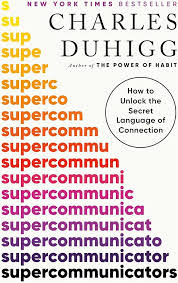
For more on how to conduct effective conversations, I highly recommend my former student Charles Duhigg's book, Supercommunicators: How to Unlock the Secret Language of Connection. Duhigg, a former writer for the New York Times, explains how to engage with others in a way that builds strong, enduring relationships.


 |
| Source: https://itsoli.ai/ |
Of course, simply having more self-confidence does not mean people actually will perform well on a subsequent task. In one of their studies, Reich and Teeny show that those who had compared themselves to an AI model did no better at a creative task than the individuals who compared themselves to other humans.
 |
| Source: Teen Vogue |
No company has mastered scarcity better than Hermès. The company markets the famous Birkin bag, named after British actress Jane Birkin, who inspired Hermès Executive Chairman Jean-Louis Dumas to create the leather bag during a conversation aboard a flight in 1984. A classic Birkin 25 bag sells for more than $12,000 today. Could the company raise prices even further? Given the even higher prices on the resale market, it seems the firm could raise prices. However, as Carol Ryan wrote this week in the Wall Street Journal, Hermès chooses to drive profitability through a different strategy. She writes:


 |
| Source: Berkeley Economic Review |